Burnout is already the norm, not the exception. A 2023 survey found that 93% of behavioral health professionals had experienced burnout, with 62% reporting severe burnout, according to HRSA's 2025 report. Hiring someone who can't sustain the emotional demands of care work doesn't just hurt retention. It affects the people they're treating.
Pre-employment testing, distinct from drug screens, background checks, and credential verification, gives employers structured, job-related evidence about communication, emotional regulation, and judgment before an offer goes out. This guide covers what to measure, how to build a fair process, the legal considerations specific to US employers, and how behavioral health organizations apply these principles in practice.
Key Takeaways
- Measure defined, job-related competencies instead of vague ideas of "culture fit"
- Combine test results with interviews, references, and credentials rather than one deciding score
- Apply the process consistently, document decisions, and provide accommodations
- Track outcomes like retention and performance to validate and refine your approach over time
What Should Pre-Employment Testing Measure?
Start With the Job, Not the Test
Before picking an assessment, document what the role actually requires: essential duties, the work environment, required knowledge, interpersonal demands, decision-making authority, and safety considerations. Skip this step, and you risk testing traits that have nothing to do with the job.
Four Categories of Assessment
Most pre-employment tests fall into one of four buckets:
| Category | What It Measures | Behavioral Health Example |
|---|---|---|
| Job knowledge/technical | Role-specific procedures, documentation, regulatory knowledge | Medication documentation accuracy for a nurse |
| Cognitive/aptitude | Reasoning, prioritization, problem-solving | Triaging competing client needs during a shift |
| Situational judgment/work sample | Realistic decisions, de-escalation, communication | Responding to a client threatening to leave treatment |
| Personality/behavioral/EI | Traits relevant to the role | Tolerance for ambiguity during a crisis |
Personality labels aren't proof of suitability on their own. Use them alongside other evidence, not instead of it.
Testing Looks Different by Role
A therapist and an admissions coordinator need different things measured:
- Clinicians and therapists: emotional regulation, therapeutic alliance potential, boundary-setting
- Peer support specialists: lived-experience application, active listening, personal recovery stability
- Case managers: organization, care coordination, follow-through under competing deadlines
- Nurses: clinical judgment, documentation accuracy, teamwork under time pressure
- Admissions coordinators: empathetic communication, resilience with distressed callers
- Supervisors: coaching ability, conflict resolution, decision-making under ambiguity
Validity and Reliability, in Plain Terms
A valid assessment measures what it claims to measure. A reliable one produces consistent results under consistent conditions.
The EEOC's selection guidance recognizes three ways to demonstrate this:
- Criterion-related evidence linking scores to performance
- Content evidence tied to job analysis
- Construct evidence connecting the trait to real work behaviors
No vendor's compliance claim substitutes for checking how a tool actually performs with your candidates.
How to Build a Fair and Effective Testing Process
Decide Where Testing Fits
Placing an assessment early, before the first interview, filters volume quickly but asks unproven candidates for more investment up front. Placing it near the finalist stage respects candidate time but means interviewing more people who may not be a fit. There's no universal answer here: weigh applicant volume against how much interview time your team can realistically absorb.
Tell Candidates What to Expect
Before testing, explain:
- Why the assessment is being used and what it measures
- How long it takes and what technology is required
- How results will factor into the hiring decision
- How to request an accommodation, and who to contact
Candidates who understand the process are more likely to complete it and trust the outcome.
Keep the Burden Proportionate
Resist the urge to build a long battery of tests. One or two well-chosen, high-value assessments usually beat five mediocre ones. A study of 222,772 applicants across 69 selection systems, Hardy et al. 2017, found that assessment length did not predict who dropped out. Most quitters left within the first 20 minutes regardless of total test length. The lesson isn't "make it longer." It's that clarity and relevance matter more than shaving minutes off a timer.

Standardize, Then Train Your Team
Use the same instructions, time limits, scoring rules, and decision thresholds for every candidate applying to the same role. Document retest policies in advance so you're not improvising case by case.
Just as important: train hiring managers to treat test results as one input, not a verdict. A strong structured interview, solid references, and relevant experience can and should outweigh a single number. Keep records of:
- Role requirements and assessment rationale
- Assessment version used
- Accommodation requests
- Decision rules
This documentation protects the process and makes it auditable later.
Legal, Ethical, and Data-Protection Considerations in the US
Review the federal, state, and local requirements that apply to your organization before using any assessment. That includes rules on discrimination, disability accommodation, privacy, consumer reports, and regulated healthcare roles.
Requirements shift by jurisdiction and by how the tool is actually used, so involve counsel for organization-specific policy decisions.
Build in Fairness Safeguards
- Apply the same job-related criteria to every similarly situated candidate
- Monitor results for adverse impact and investigate less-discriminatory alternatives that measure the same competency
- Provide reasonable accommodations without assuming anything about disability, diagnosis, recovery status, or other protected characteristics
Keep Assessment Data Separate From Medical and Drug-Testing Records
A behavioral or skills assessment is not a medical exam, and it shouldn't be stored or handled like one.
Practical handling steps include:
- Restrict access to assessment results
- Set clear retention limits
- Store records securely
- Tell candidates plainly what's collected and why
Care Predictor, for instance, collects only the minimal personal information needed to generate a Care Profile report and encrypts data both at rest and in transit.
Remote Testing Has Its Own Risks
Identity verification, accessibility, unreliable internet, outside assistance, and privacy all become harder to manage once testing moves off-site.
Any monitoring or proctoring should be proportionate to the risk, disclosed in advance, and reviewed for legal and ethical concerns. Don't add it simply because a vendor offers the feature.
A Caution on Paid Work Demonstrations
If you ask a candidate to perform an actual work task, define upfront whether it's simulated, paid, supervised, or part of real work. Examples include trial shifts and live client interactions.
Unclear answers here can create wage, safety, or workers' compensation exposure. Get jurisdiction-specific advice before building this into your process.
How to Apply Testing in Behavioral Health Hiring
Translate Competencies Into Assessment Design
For care roles, the competencies that matter most rarely show up on a resume: compassionate communication, emotional regulation, the ability to form a therapeutic alliance, teamwork across disciplines, sound judgment, and reliability under pressure. Pair assessments built around these with structured behavioral interview questions, realistic care scenarios, reference checks, licensure verification, and role-specific work samples.

Where Care Predictor Fits
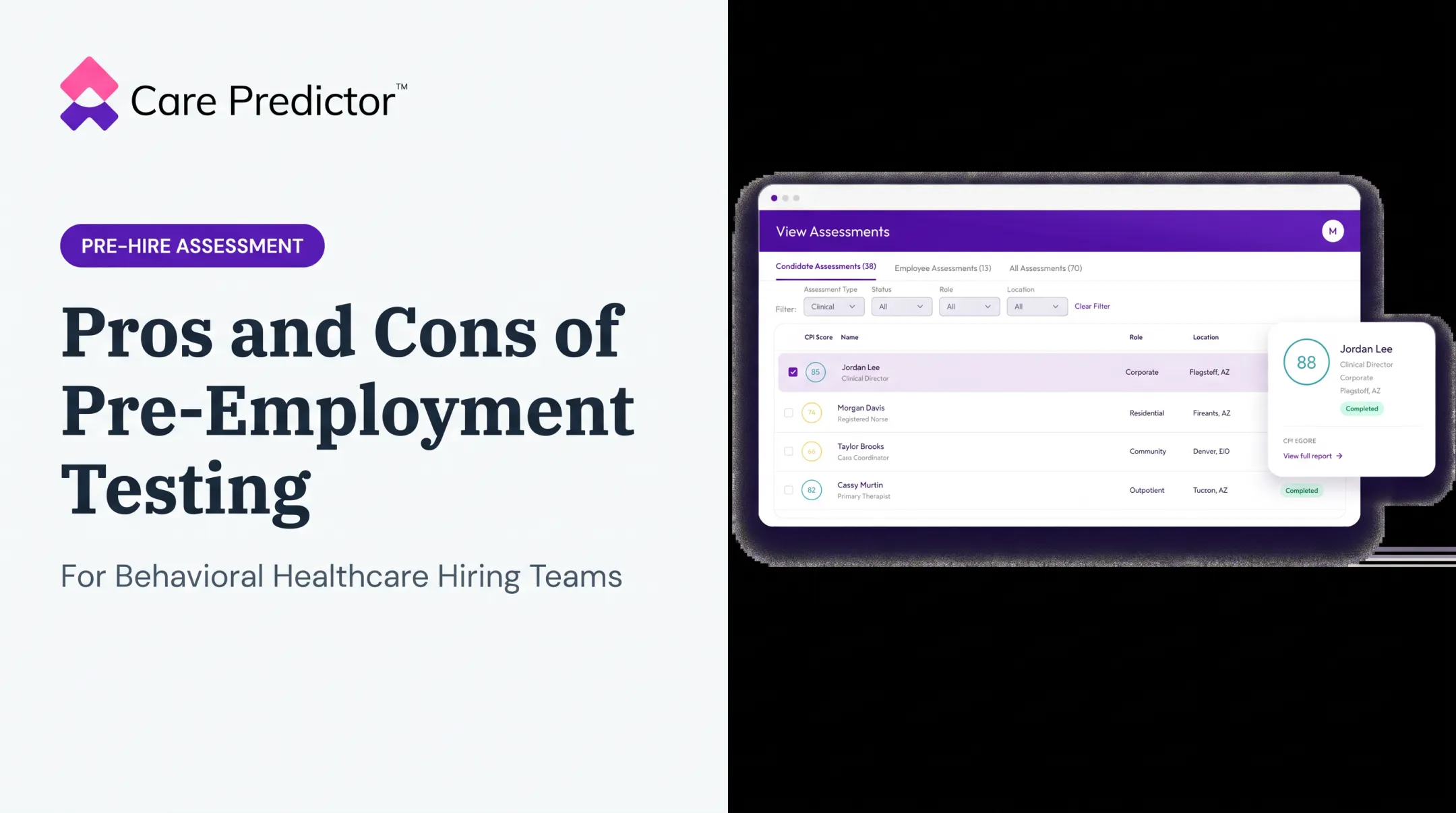
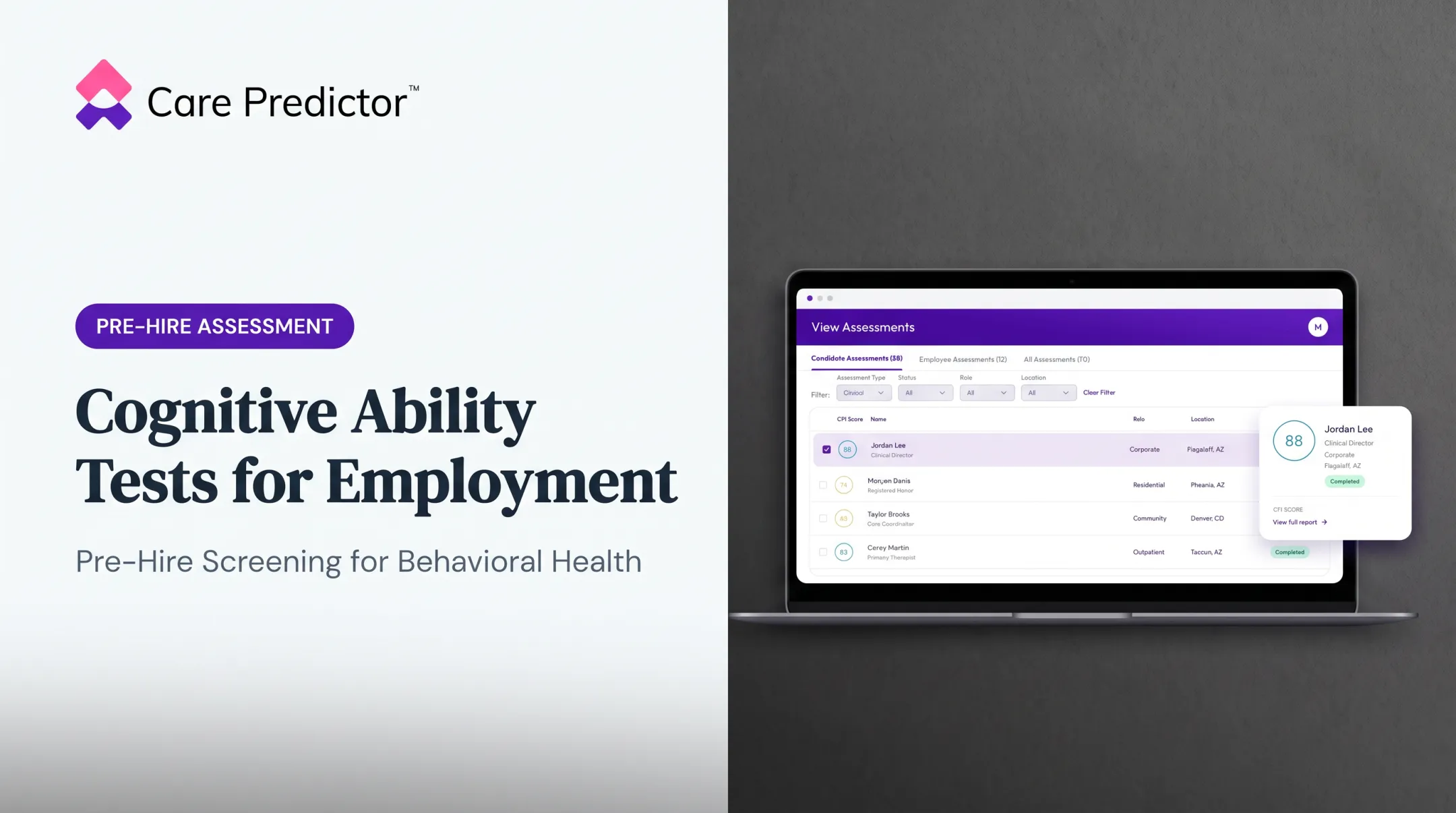
Care Predictor's Pre-Hire Care Profile is one example of a behavioral-health workforce intelligence platform built around this idea. It evaluates candidates across 24 research-verified attributes tied to relational strengths, role readiness, and performance under pressure, then gives hiring teams role-specific interview questions based on each candidate's report.
In reverse-validation work across 30 therapists at four treatment centers, higher Care Predictor Index scores correlated with higher treatment completion and client satisfaction, and lower rates of patients leaving against medical advice. None of this replaces human judgment. The report is meant to sharpen the interview, not decide the outcome. Technology should strengthen the human connection at the center of care, not stand in for it.
Use Results Beyond the Hiring Decision
A candidate's assessment profile doesn't have to stop mattering after the offer letter. It can inform:
- Onboarding priorities and early coaching focus
- Manager development plans for new supervisors
- Leadership development pipelines
- Staff engagement follow-up after the first 90 days
Treat these as starting points for conversation, not fixed labels.
Build a Post-Hire Measurement Plan
Compare assessment signals against outcomes that matter to your organization: early performance, retention, staff satisfaction, team stability, treatment completion, or patient retention. Before running these comparisons, work out appropriate privacy, consent, and statistical safeguards, since a small sample size or an unrepresentative cohort can produce misleading conclusions.
Review results across roles and demographic groups. If a pattern looks off, investigate it rather than assuming the test is fine. Update assessments when job duties, care models, technology, or workforce needs shift.
Common Mistakes to Avoid and How to Improve
Even well-intentioned testing programs fail in predictable ways:
- Generic, untethered assessments: an off-the-shelf personality test with no connection to actual job duties
- Over-testing: stacking multiple assessments until qualified candidates abandon the process
- Inaccessible formats: tests that don't work with assistive technology or lack clear instructions
- Excessive monitoring: proctoring that feels invasive relative to the actual risk
- Inconsistent administration: different time limits or undocumented exceptions for different candidates
- Arbitrary cut scores: automatic rejections based on one number, with no documented rationale
Any one of these can make a qualified candidate walk away, or make your process legally vulnerable.
Build a Recurring Review Cycle
Revisit your process regularly using:
- Hiring-manager and candidate feedback
- Completion and drop-off data
- Accommodation requests
- Post-hire performance and retention
- Adverse-impact analysis by role and group
One more reminder: drug screens and background checks answer entirely different questions from behavioral or skills assessments. Staff turnover in substance use treatment has reached as high as 50% by SAMHSA's estimates. Testing alone won't fix that.

Each type of screening still needs its own policy, consent process, and data-handling rules rather than being lumped together.
Frequently Asked Questions
What is considered pre-employment screening?
Screening is the broader umbrella covering qualifications, skills, job-related behaviors, references, credentials, background information, and, where lawful and relevant, drug or health-related checks. A single assessment is just one piece of that process.
What do pre-employment urine tests test for?
Urine tests screen for substances included in the employer's selected panel, and panels vary by organization and role. Consent, Medical Review Officer procedures where applicable, confidentiality, and federal, state, and local requirements all need to be addressed.
Can you still get hired if you fail an assessment test?
It depends on your documented policy, the assessment's purpose, and the full body of evidence, including whether an accommodation, technical issue, or legitimate explanation applies. One score should never automatically replace a holistic evaluation.
How do employers choose the right pre-employment test?
Start with a job analysis, identify measurable competencies, and confirm evidence of validity and reliability. Then weigh accessibility and candidate burden, and verify the test fits the specific role you're hiring for.
Are pre-employment tests required to be job-related and validated?
Employers should use job-related selection procedures backed by appropriate validity evidence. Review applicable US equal-employment, disability, and privacy requirements with qualified counsel before launching any assessment program.