The stakes are real. In a 2023 survey, 83% of the behavioral health workforce believed providers would struggle to meet treatment demand without policy changes, according to the National Council survey. Turnover compounds the problem: SAMHSA has found substance abuse treatment staff turnover reaching as high as 50% in a given year.
Pre-employment assessment tools add structure to a hiring process that often relies on gut feel. This guide compares five tools relevant to behavioral health hiring and gives you a framework for judging validity, fairness, security, and practical value.
Key Takeaways
- The right assessment tool depends on your role, hiring volume, assessment type, and the evidence behind it
- Behavioral health hiring should weigh compassionate communication, judgment, teamwork, and resilience, alongside clinical competency
- Care Predictor is built specifically for behavioral health workforce intelligence; other tools fit general, high-volume, or technical hiring
- Validate relevance, monitor adverse impact, protect candidate data, and pilot before scaling any tool
Overview of Pre-Employment Assessment Tools in Behavioral Health
Pre-employment assessment tools are platforms that gather structured information about candidates before you make an offer. That can include skills tests, cognitive assessments, behavioral assessments, situational judgment tests, job simulations, structured interviews, and asynchronous video interviews.
Resume screening alone misses a lot. Two candidates can hold the same license and differ wildly in empathy, emotional regulation, communication under pressure, and their ability to collaborate inside a demanding care environment. That gap is exactly where assessments add value.
Nationally, 54% of organizations now use pre-employment assessments to gauge applicant knowledge, skills, and abilities, according to SHRM's 2024 survey. That figure spans all industries, not behavioral health specifically, but it signals how mainstream structured assessment has become.

Mapping Assessment Types to Behavioral Health Roles
Different roles call for different measurement tools:
- Clinical staff and counselors: behavioral assessments measuring emotional regulation, relational strengths, and situational judgment
- Behavioral health technicians: situational judgment tests and realistic job previews for high-pressure, direct-care moments
- Admissions and care coordination teams: communication assessments and structured interviews focused on empathy under time pressure
- Administrative and support staff: skills tests for scheduling, documentation, and office software
No single assessment predicts success for every role. The tools below should be compared on role relevance, scientific evidence, candidate experience, security, integrations, and total cost, not brand recognition.
Best Pre-Employment Assessment Tools for Behavioral Health Organizations
This comparison is curated for US behavioral health providers. Features, pricing, and certifications change often, so verify current details on each vendor's site before you commit.
Care Predictor : Best for Behavioral Health Workforce Intelligence
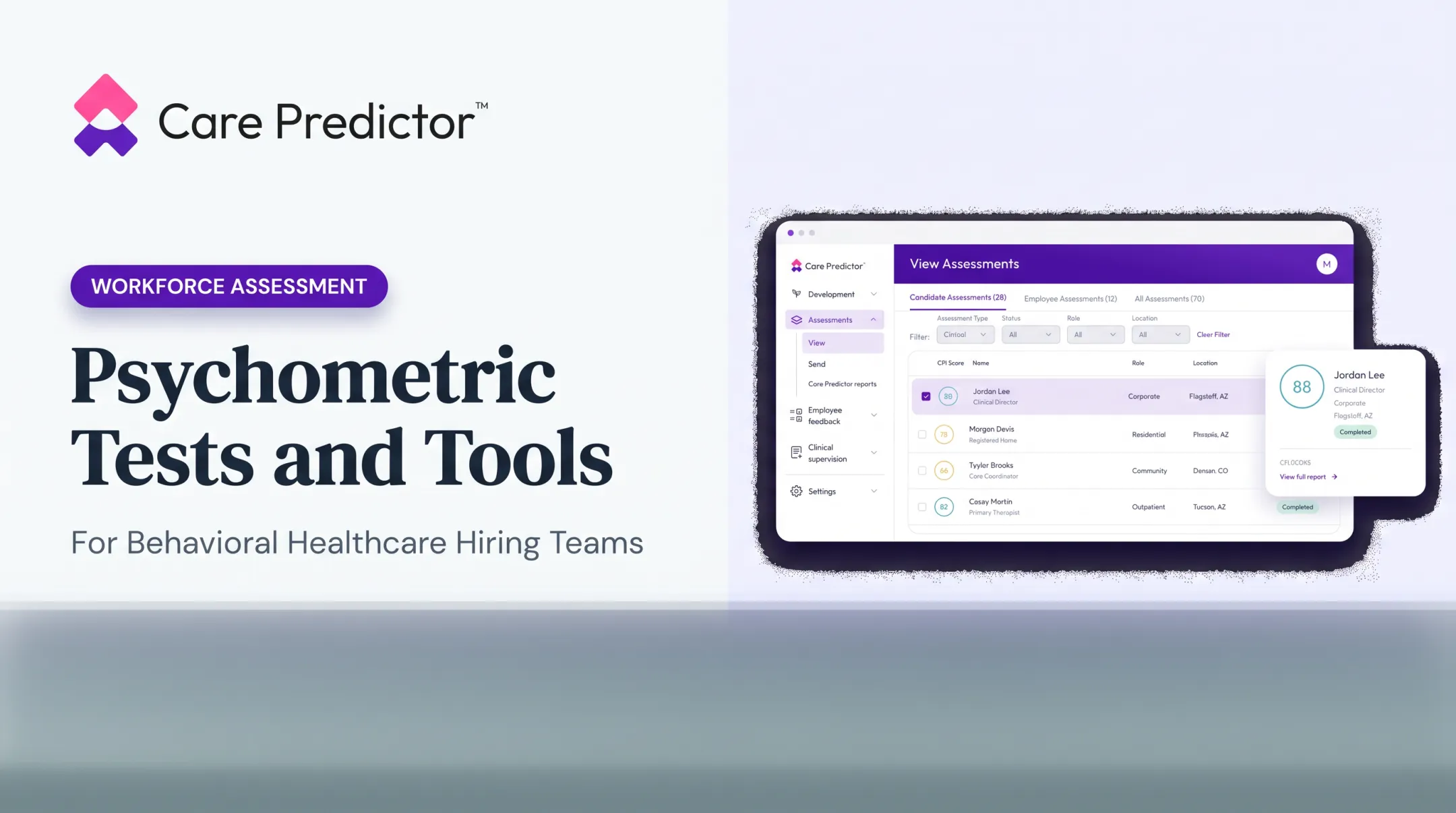
Care Predictor is built specifically for behavioral health, not retrofitted from a general HR tool. It combines behavioral science with data analytics across assessment, interviewing, prediction, and staff engagement.
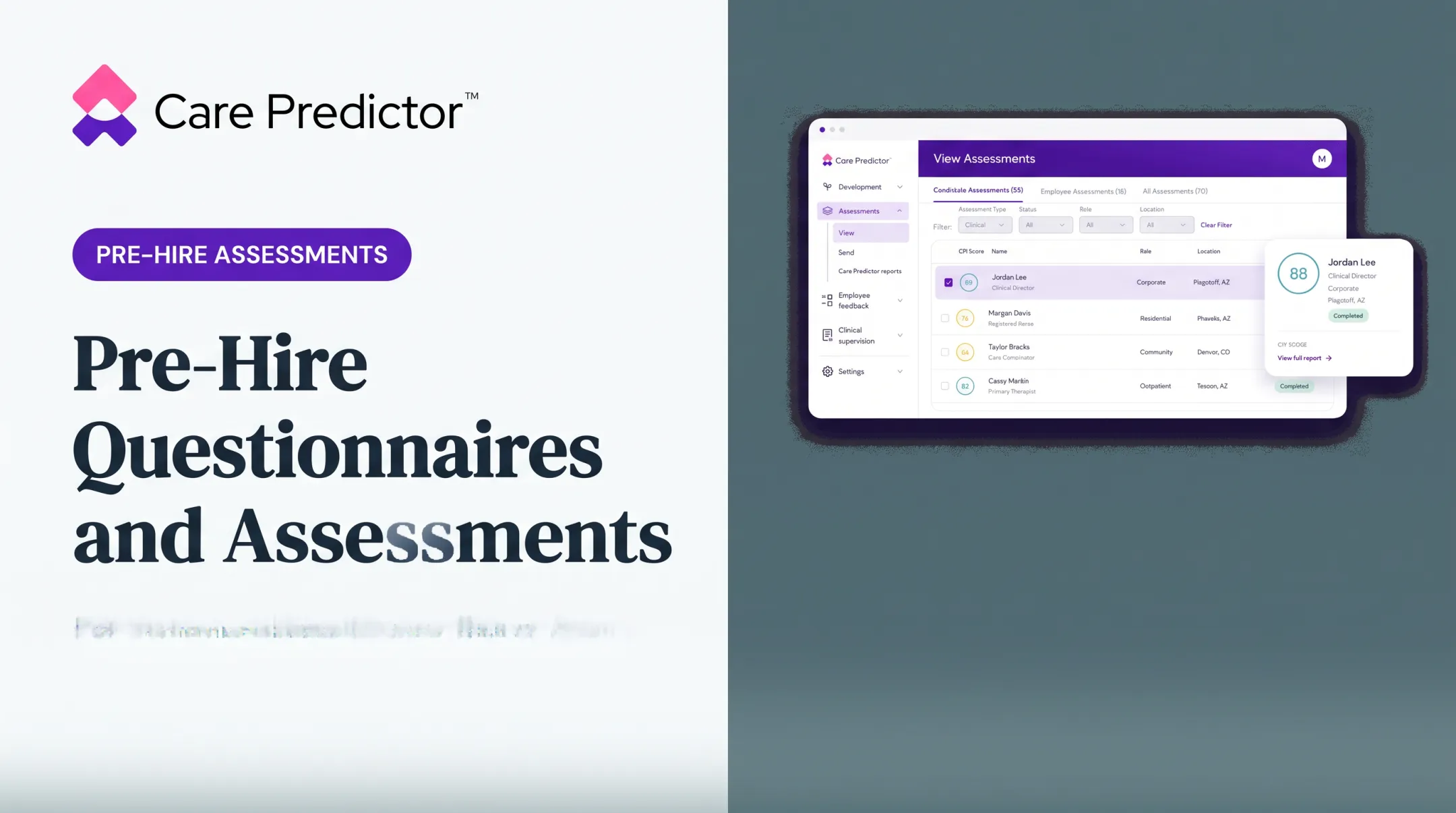
The platform's Pre-Hire Care Profile Assessment evaluates candidates across 24 research-verified behavioral attributes, surfacing relational strengths, role readiness, and how a candidate is likely to perform in high-pressure care settings. It pairs that with a candidate fit dashboard, behavioral insight reports, and role-specific interview guides.
Care Predictor's own validation data, drawn from two years and 7,325 treatment episodes, found that therapists scoring 80 or above on their Care Profile completed 25% more treatments and lost 29% fewer patients to AMA discharge.

The company lists Lisbon Addictions 2024, the National Institute for Behavioral Health, and Biddle Consulting Group among its validation partners, and describes its models as cross-validated across multiple independent samples.
| Feature | Details |
|---|---|
| Assessment focus | Behavioral attributes, role fit, candidate-team alignment |
| Interviewing support | Role-specific interview guides generated from candidate reports |
| Onboarding/lifecycle | New-hire check-ins, development planning, employee Care Profiles (Grow plan) |
| Integrations | Standalone by default; HRIS/EHR integration available for expanded reporting |
| Security | ISO 27001:2022, SOC 2, PCI-DSS 4.0, NIST Cybersecurity Framework |
| Pricing | Hire & Keep: $499/month; Grow and Enterprise: custom quote |
Care Predictor is an official Strategic Workforce Development Partner for CCAPP and reports it's trusted by more than 100 organizations, including Aspire, Havenwood, and HopeHorizon. No EMR integration is required to get started.
Criteria : Best for Research-Backed General Workforce Assessments
Criteria offers cognitive, personality, emotional intelligence, risk, and skills assessments across many role families. For behavioral health providers, it may fit administrative, operational, or customer-facing roles where a general cognitive or personality baseline is useful. Always confirm whether a given assessment is validated for your specific job and population.
| Feature | Details |
|---|---|
| Assessment categories | Cognitive, personality, emotional intelligence, risk, skills |
| Reporting/integrations | Hiring-metric analytics; ATS/HRIS partnerships |
| Accessibility | Mobile-friendly; UCognify and UCAT offered as language-independent cognitive tests |
| Documentation | CCAT guide cites 700,000+ assessments but does not publish reliability/validity coefficients publicly |
| Pricing | Request-pricing model (Assess, Interview, Hire packages) |
Harver : Best for High-Volume and Frontline Hiring
Harver is worth investigating for high-volume hiring where you need standardized screening at scale. Its library spans more than 450 assessment options, including gamified behavioral tests, cognitive reasoning, situational judgment tests, and realistic job previews.
That combination could apply to admissions, patient access, or behavioral health technician roles, provided scenarios are written to reflect what the job actually demands rather than generic customer-service situations.
| Feature | Details |
|---|---|
| Library | 450+ assessments, dozens of languages |
| Integrations | Workday-certified integration (announced Nov. 2024); ATS stage/status sync |
| Candidate workflow | Candidate- and recruiter-centric views; auto-loaded results |
| Security | SOC 2 Type I, ISO 27001:2022 |
| Pricing | Not publicly listed; request quote |
Vervoe : Best for Practical Work Samples and Job Simulations
Vervoe's work-sample approach lets you watch candidates perform representative tasks instead of relying only on self-report answers. In a behavioral health context, that might mean documenting a simulated patient interaction, responding to a difficult communication scenario, or drafting a clear, patient-facing message.
Keep simulations within the lawful scope of the role; don't use them to evaluate clinical decisions a candidate isn't licensed to make.
| Feature | Details |
|---|---|
| Formats | 10 question types, including code challenges and video responses |
| Scoring | Rubric-based model plus NLP scoring; recruiters can inspect or override scores |
| Accessibility | Works with screen readers, keyboard navigation, speech-to-text; extra time available on request |
| Security | ISO 27001 certified, GDPR compliant; no public SOC 2 claim found |
| Pricing | Custom, based on volume and workflow |
TestGorilla : Best for Broad Early-Stage Skills Screening
TestGorilla works well as an early-stage filter across cognitive, language, software, and role-specific skills. For behavioral health organizations, that's most useful for scheduling, data entry, customer service, and basic office-software roles. Generic skills tests shouldn't stand in for a compassion or clinical-readiness assessment.
| Feature | Details |
|---|---|
| Library | 350+ skills tests; custom tests and AI-recommended questions |
| Candidate experience | Consistent AI-interview questions and criteria |
| Accessibility | Candidates can request assessment modifications |
| Pricing | Free (10 credits/mo); Core from $215/mo; Plus from $520/mo, billed annually |
| Validation | Internal psychometrician review cited; no public coefficients found |
How We Chose the Best Pre-Employment Assessment Tools
Picking a tool starts before you ever compare vendors. First, identify what actually predicts success and failure in the role. Then shortlist tools built to measure those factors, verify the vendor's evidence, and run a defined pilot before rolling anything out organization-wide.

Scientific Validity and Job Relevance
Ask whether the vendor publishes a technical manual, reliability and validity evidence, and a clear explanation of what each score means. The SIOP/APA Principles for personnel selection emphasize that scores must reliably predict actual work behavior, not just correlate with a test format.
Request role benchmarks, not just a general validity claim.
Behavioral Health Fit
Scenarios should reflect real care environments, not generic customer-service situations borrowed from retail hiring. Check whether:
- Situational judgment items avoid stereotyping patients or conditions
- Results support onboarding and development, not just a pass/fail rejection
- The tool complements structured interviews rather than replacing them
Fairness, Accessibility, and Privacy
Monitor for adverse impact and confirm the vendor supports accommodations and language access. The EEOC notes that software and algorithms can screen out people with disabilities, and applicants can request an accommodation so an assessment measures ability rather than disability.
Also review:
- Candidate consent and data retention practices
- Whether AI analyzes resumes, video, audio, or facial features
Operational Value
Finally, weigh the practical side: ATS/HRIS integration, implementation effort, mobile usability, and support. Pilot one high-volume role first, and track:
- Completion rate and time-to-review
- Interviewer agreement after the assessment is introduced
- Early quality-of-hire indicators and retention at 90 days
- Candidate feedback on the experience itself
Conclusion
The best pre-employment assessment tool is the one that measures what actually matters for a specific behavioral health role, and strengthens your team's judgment rather than replacing it. Before you commit to any platform, compare:
- Scientific evidence
- Candidate experience
- Security and accessibility
- Integration options
- Total cost
Care Predictor built its approach around this exact problem: combining behavioral science and data analytics to help providers hire, engage, and retain staff who deliver better care. If you're evaluating how a role-specific assessment could fit your hiring process, talk with the team about applying that research to your organization.
Frequently Asked Questions
How do you assess candidates for a job?
Define the job-related competencies first, then apply a consistent process combining structured assessments, interviews, and work samples where relevant. Offer accommodations when requested, and keep a human reviewer in the loop for every decision.
What are some effective assessment tools for hiring?
Effective options include skills tests, work samples, situational judgment tests, validated cognitive or behavioral assessments, and structured interviews. Role-specific platforms, such as Care Predictor for behavioral health, add another layer of relevance.
What is a talent assessment?
A talent assessment is a structured method for evaluating a candidate's capabilities, behaviors, knowledge, or role alignment before or during hiring. In behavioral health, that might include measuring emotional regulation or communication style alongside clinical skills.
What red flags do you look for when screening candidates?
Watch for unexplained employment or credential gaps, inability to demonstrate required skills, poor judgment in realistic scenarios, and disrespectful communication. Any red flag deserves verification, not automatic rejection.
What are the top 5 questions to ask a candidate?
Ask about a challenging care or service interaction, a teamwork conflict, an ethical judgment call, how they responded to tough feedback, and how they prioritize under pressure. Adapt wording to the specific role and score answers with a consistent rubric.
What are the 5 C's of interviewing?
One common version, from Indeed's interviewer guide, lists Clarity, Curiosity, Consistency, Competency, and Culture. Treat it as a helpful framework for structuring conversations, not a validated assessment on its own.