Introduction
By the time an exit interview happens, the decision is already made. The employee has accepted another offer, packed up their desk, or quietly resolved to leave the moment something better comes along.
For behavioral health organizations, that timing gap is costly. A therapist's departure disrupts client continuity, a nurse's exit forces overtime onto an already-stretched unit, and a counselor's resignation leaves caseloads that can't simply pause.
Gallup's research on voluntary departures found that 42% of employees who left said their exit could have been prevented. Another 45% had no proactive conversation about their work in the three months before quitting. Waiting for an exit interview means asking the right question only after it's too late to act.
A retention survey changes that timing. It asks current staff how they're doing while there's still room to respond.
This guide shares ready-to-use retention survey questions for clinical, care, administrative, and support teams. You'll also get practical guidance on design, anonymity, analysis, and follow-through, including burnout, supervision, workload, staffing coverage, career growth, and team stability.
Key Takeaways
- Measure both intent to stay and the specific workplace conditions driving that intent
- Mix scaled, multiple-choice, and open-ended questions tailored to clinical and support roles
- Protect anonymity, segment responsibly, and always explain what action will follow
- Treat results as a pattern-spotting tool, not proof of an individual's plans
- Pair survey data with actual turnover, absenteeism, and exit-interview data for full context
What Is an Employee Retention Survey and Why Does It Matter?
An employee retention survey is a structured questionnaire that measures how likely employees are to stay and identifies the workplace factors that could change their minds. It's easy to confuse with a few other tools HR teams use:
| Tool | Who answers | What it reveals |
|---|---|---|
| Retention survey | Current employees | Current risk, measured across teams |
| Engagement survey | Current employees | Broad drivers of commitment and effort |
| Exit survey | Departing employees | Why people already left |
| Stay interview | One employee, one manager | What keeps this specific person here |
A retention survey occupies a useful middle ground: broad enough to catch patterns, timely enough to act before someone resigns.
Why Behavioral Health Needs a Different Approach
Clinical and direct-care staff manage trauma exposure, variable patient acuity, and high-stakes decisions that most office jobs never touch. Add chronic staffing gaps and documentation backlogs, and burnout risk climbs fast.
The stakes extend beyond staffing convenience. The relationship between a clinician and a patient (the therapeutic alliance) accounts for an estimated 7% to 10% of variance in treatment outcomes, and strong alliances can cut dropout rates in half. When a clinician leaves mid-treatment, that relationship breaks along with the schedule.

One caution: survey responses are indicators, not verdicts. An employee who disagrees with "I see myself here in 12 months" isn't guaranteed to quit, and treating that score as evidence against them will backfire fast.
Use results to spot patterns and start supportive conversations, not to flag individuals for extra scrutiny.
Done well, this data supports more than headline retention numbers. It can point to:
- Where supervisor coaching is needed
- Which onboarding steps aren't landing
- Where staffing models need rethinking before vacancies pile up
Care Predictor's platform, for instance, connects onboarding pulse checks at 30, 60, and 90 days with later engagement data, so patterns surface before they become resignations.
Employee Retention Survey Questions to Ask Behavioral Health Employees
Keep response design simple:
- Use a consistent five-point agreement scale for most statements
- Include a small number of direct intent-to-stay items
- Mark open-ended questions optional
Each question should measure one idea, use neutral wording, and reference a clear timeframe when asking about recent workload, supervision, or burnout experiences.
Intent-to-Stay and Retention-Risk Questions
- "I see myself working at this organization 12 months from now."
- "I have seriously considered leaving this organization in the past six months."
- "What, if anything, might cause you to leave this organization?" (optional)
- "What is the one change that would most increase your commitment to staying?" (optional)
Manager, Supervision, and Psychological-Safety Questions
- "My supervisor provides feedback that helps me improve my work."
- "I receive the clinical or role-specific support I need when cases become difficult."
- "I feel safe raising concerns about patient care, staffing, or workplace conditions."
- "My supervisor treats team members fairly and consistently."
Workload, Burnout, and Operational-Support Questions
- "My workload is manageable during a typical shift or workweek."
- "Staffing levels allow me to provide the quality of care expected."
- "I have enough time to complete documentation and other required tasks."
- "How often have you felt emotionally exhausted by work during the past month?"
Growth, Recognition, Compensation, and Mission-Alignment Questions
- "I can see a realistic path for professional growth here."
- "This organization supports the training and development I need."
- "My contributions to patient care and team performance are recognized."
- "My pay and benefits are fair for my role, credentials, and local market."
- "I understand how my work contributes to the organization's mission and patient outcomes."
Open-Ended Prompts
- "What helps you do your best work here?"
- "What makes your role harder than it needs to be?"
- "What support would make it easier for you to continue in this role?"
- "Is there anything leadership should understand about the employee experience on your team?"
Don't ask every item above in one sitting. Pick the dimensions most relevant to your current priorities, build a focused core survey, and follow up with shorter pulse surveys for anything that needs closer tracking.
How to Design a Trustworthy Employee Retention Survey
Start with a specific objective: understanding early-tenure attrition, identifying burnout drivers among direct-care staff, evaluating supervisor support, or assessing a recent operational change. A vague goal produces a vague survey.
Build the questionnaire around a small set of dimensions:
- Intent to stay
- Supervisor support
- Workload and wellbeing
- Growth, recognition, and compensation
- Team culture and communication
- Resources and mission alignment
Match the question type to the job it needs to do:
- Likert-scale statements for tracking trends across teams and survey cycles
- Yes/no or multiple-choice questions for quick operational signals
- Rating questions for overall satisfaction or likelihood to recommend
- Open-ended questions for context, examples, and suggested fixes
Protecting Anonymity and Trust
Explain upfront who will see responses. Report results only for groups large enough to protect identity, and keep optional contact information separate from survey answers.
A five-person night shift combined with role and tenure filters can still identify a respondent even when overall headcount looks safe. Suppress or combine small cross-tabs rather than publishing them.
Use wording that works across nurses, therapists, peer-support specialists, technicians, counselors, and administrative staff. Not every employee provides direct patient care, so avoid questions that assume otherwise.
Cadence, Pilots, and Follow-Through
Run a broader diagnostic periodically, shorter pulse surveys in between, and targeted check-ins after major staffing, leadership, or policy changes.
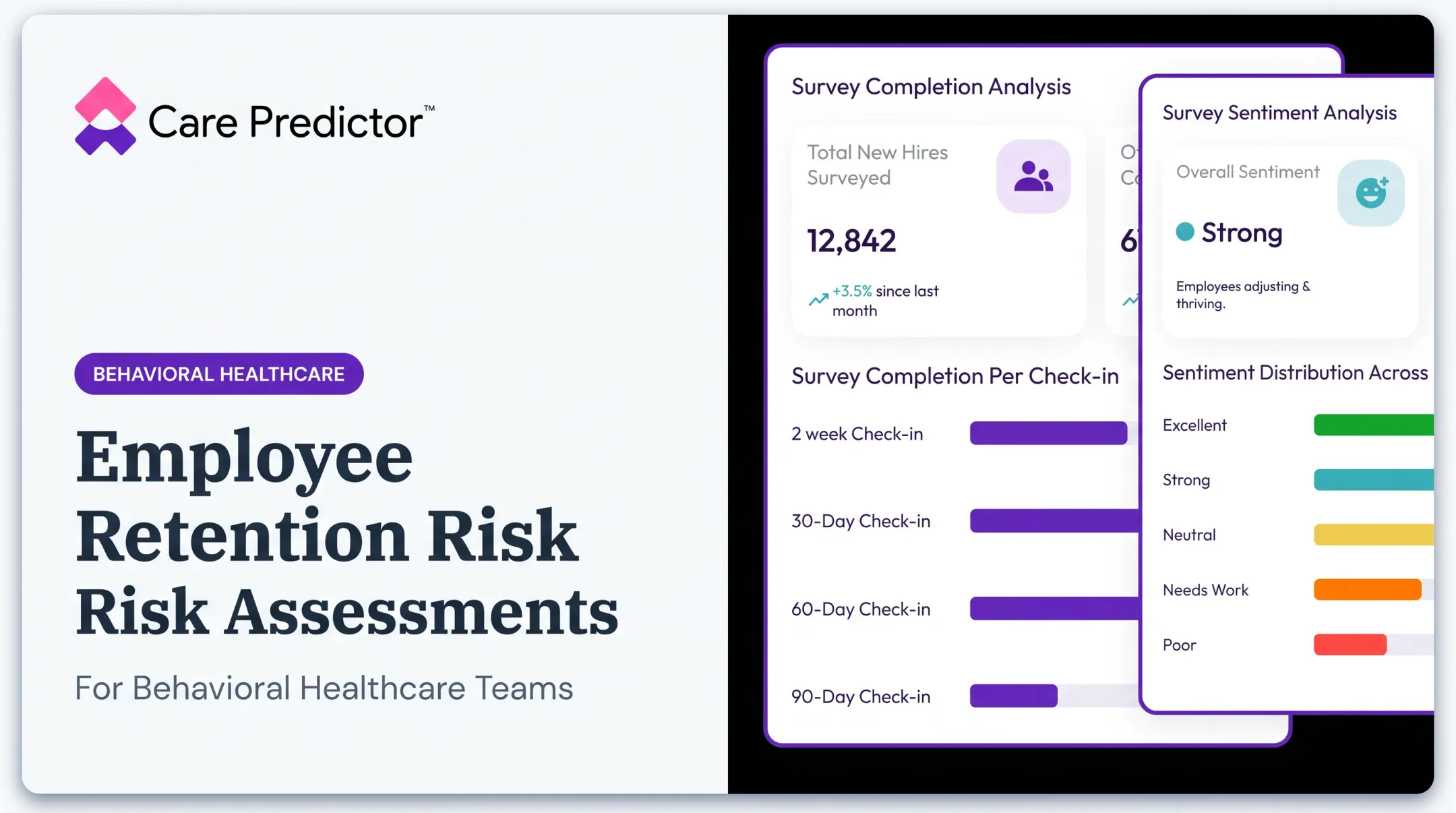
Care Predictor's onboarding pulse structure uses checkpoints at 30, 60, and 90 days. Completion rates commonly start near 92% at two weeks and drop toward the mid-50s by day 90. That decline is useful data about where engagement starts to slip.

Pilot the survey with a small, representative group before launch. A night-shift nurse, a counselor, a peer worker, and a front-office employee will catch confusing wording or shift-unfriendly options faster than internal review alone.
Tell employees how results will be used, and commit to sharing a summary once the survey closes.
How to Analyze Retention Survey Responses
Start with participation, not results. Review completion patterns and whether certain roles, shifts, or locations are underrepresented. In Care Predictor's own data across more than 12,800 surveyed new hires, overall completion landed at 67%, with sharp drop-off between the two-week check-in (92%) and the 90-day mark (54%). That decline is itself a signal worth watching.
Keep two categories of questions separate:
- Direct intent-to-stay items, which show whether employees are actively reconsidering their future
- Diagnostic items, which show dissatisfaction with a specific issue
Conflating the two leads to the wrong fix — fixing a parking complaint won't stop someone who's already decided to leave.
Compare results across meaningful, privacy-protected segments: tenure, role family, shift, department, and supervisor group. Suppress or combine groups too small to protect anonymity.
Then look for relationships between intent to stay and factors such as:
- Workload
- Supervisor support
- Psychological safety
- Schedule predictability
Analyze open-ended responses by theme. Common categories in behavioral health settings include:
- Staffing coverage
- Supervision
- Compensation
- Documentation
- Safety
- Professional development
Include representative comments only after removing identifying details.
Calculating Retention Rate
The standard cohort formula: employees who remained employed throughout the period, divided by employees present at the start of the period, multiplied by 100. Define the period clearly, and specify whether you're measuring overall, voluntary, role-specific, or tenure-specific retention. These numbers aren't interchangeable.
Compare survey findings with actual turnover, absenteeism, vacancy, and overtime data where appropriate. A dashboard that pairs sentiment with operational metrics (for example, 145 active employees, average tenure just over 10 months, and a 5% quarterly turnover rate) gives leaders a clearer picture than survey scores alone.

That pairing is the idea behind Care Predictor's workforce analytics: connect hiring, onboarding, and engagement data so survey responses support human decisions, with individual responses kept confidential.
From Survey Findings to Employee Retention Action
Not every finding deserves immediate action. Prioritize findings with three filters:
- Signal strength — how consistent and strong is the pattern?
- Scope — how many employees, or how critical a role, does it affect?
- Feasibility — can leaders realistically act within a defined timeframe?
Convert findings into role-specific moves:
- Supervisor coaching for teams reporting low psychological safety
- Clearer clinical escalation pathways for complex-case stress
- Workload and scheduling reviews where burnout scores cluster
- Career-development plans for teams citing limited growth
- Additional support protocols after difficult patient-care events
Involve managers and frontline staff in interpreting results, but share team-level themes and conversation prompts — never identifiable individual responses.
Close the loop. Tell employees:
- What the organization heard
- What will change, and what can't change right now
- Who owns each action
- When progress gets reviewed
Gallup's workplace research found that workgroups scoring high on survey-driven action planning saw engagement scores rise by 10%, while low-action groups saw a 3% decline. Following through beats filing results away.

Common failure points to avoid:
- Surveying without acting on results
- Treating low scores as an employee performance problem
- Overpromising confidentiality you can't actually deliver
- Publishing identifiable open-text comments
- Assuming one retention fix works across every role and tenure group
Frequently Asked Questions
What are some good survey questions to ask employees about retention?
Cover intent to stay, manager support, workload, burnout, growth, recognition, and psychological safety. Add one open-ended question on what would make the employee more likely to stay.
How do I calculate my retention rate?
Divide the number of employees who stayed through the full period by the number present at the start, then multiply by 100. Define your time period, population, and whether you're measuring overall or voluntary retention.
What are the top 5 employee retention strategies?
In behavioral health settings, the strategies that rank highest are:
- Supportive supervision
- Manageable workloads
- Clear career development paths
- Fair compensation and recognition
- Visibly acting on employee feedback
What are the top 3 retention issues for line employees?
Workload and burnout, weak supervisor or team support, and unclear growth, scheduling, or compensation expectations show up most often. Use your survey data to confirm which issue matters most in your organization.
What are the 5 C's of employee retention?
There’s no single universal model; one common set is compensation, career, conditions, culture, and communication. Use those categories to shape survey themes—don’t force your results into a rigid framework.