Introduction
Hiring in behavioral healthcare takes more than checking credentials and counting years of experience. Organizations also need to know how candidates approach compassion, integrity, accountability, teamwork, and patient-centered care under pressure.
Staff turnover in substance use treatment has been reported as high as 50%, according to SAMHSA data cited by workforce researchers. That kind of churn disrupts patient relationships and strains remaining staff.
Values-based assessment tests give hiring teams a structured way to address that risk. They examine how a candidate's work-related values and likely behaviors align with clearly defined organizational expectations, rather than relying on a subjective "culture fit" gut check.
This article covers test formats, implementation steps, behavioral-health applications, and the limitations you need to manage responsibly.
Key Takeaways
- Values-based tests measure job-relevant behaviors and complement skills, interviews, and credentials—not replace them.
- Strong assessments turn broad values into observable behaviors with consistent scoring.
- Tie results to compassionate care and team stability without overstating predictive power.
- Fair use requires job relevance, validated methods, accessibility, and ongoing bias review.
What Are Values-Based Assessment Tests—and Why Do They Matter?
A values-based assessment, in employment terms, measures how closely a candidate's work-related priorities and likely behaviors match the values an organization has defined as essential for a role. That's a narrower claim than it might sound.
It is not the same as:
- Personal values questionnaires built for self-reflection
- Personality inventories that measure traits like extraversion
- Emotional-intelligence tests of capacity to manage emotions
- Conventional competency tests of demonstrated skills
Researchers studying person-organization fit describe it as congruence between an individual's and an organization's norms and values. This doesn't mean candidates must share identical backgrounds, beliefs, or personalities. It means their behavioral responses to work situations line up with what the role actually requires.
Where Values Show Up on the Job
Consider how values shape real decisions:
- How a counselor responds to a patient in emotional distress
- Whether a technician protects confidentiality under social pressure
- How a case manager accepts corrective feedback
- Whether a team member steps up during a staffing shortage
These moments matter more in behavioral health than in many other industries, since the quality of human connection, consistency, and ethical judgment directly shapes patient experience.
What the Research Actually Shows
A widely cited 2005 meta-analysis of 110 person-organization fit studies found fit correlated with job satisfaction (rho = .44) and intent to quit (rho = -.35) across more than 40,000 employees.
That's meaningful, but the studies pooled varied fit measures across many industries. They don't validate any single values test for behavioral-health hiring.
The honest takeaway: values assessment works best as one input among several, not a standalone filter.
Common Types and Formats of Values-Based Assessments
Not all tools measure the same thing, and format matters less than validation does. Here's how the main approaches compare:
| Format | What it measures | Limitation |
|---|---|---|
| Self-report questionnaire | Stated value priorities | Vulnerable to socially desirable answers |
| Forced-choice/ranking | Relative priority between values | Reduces faking but adds complexity |
| Situational judgment test | Judgment in realistic scenarios | Validity varies widely by study |
| Behavioral interview | Past behavior as a predictor | Depends heavily on interviewer skill |
| Job simulation | Actual behavior under task conditions | Resource-intensive to build and score |
Personal Frameworks Aren't Hiring Tools
Instruments like the Schwartz Portrait Values Questionnaire or the Valued Living Questionnaire are legitimate, well-studied tools. But they were built for research on personal value priorities and clinical work within acceptance and commitment therapy, respectively. Neither one comes with evidence that it predicts job performance or belongs in a hiring pipeline.
Stated Values vs. Demonstrated Behavior
Here's the gap that trips up a lot of hiring teams: asking "Do you value compassion?" gets you a yes almost every time. Asking a candidate how they'd handle a patient who refuses treatment tells you something closer to the truth. The difference is practical:
- Scenario-based formats force a choice in context
- Self-report formats invite the answer the candidate thinks you want
A 2020 meta-analysis of 26 situational judgment studies in medical selection found a pooled validity coefficient of .32, but with substantial variation between studies (I² = 96.5%). Format alone doesn't guarantee accuracy. Scoring, job relevance, and validation evidence all have to hold up independently.
Online, Interviewer-Led, or Blended?
- Online tests scale easily and score consistently, but can't capture nuance.
- Interviewer-led assessments pick up context, but introduce rater variability.
- Blended approaches generally perform best, pairing standardized scoring with human judgment.
Whatever delivery mode you choose, check the instrument itself before you buy: it should be validated for employee selection, tested on a population similar to your roles, and compliant with U.S. licensing and employment-law requirements.
How to Design and Use a Values-Based Assessment Test
Building a usable assessment starts long before you write a single question.
Step 1: Start With a Job Analysis
Identify the specific situations behavioral health employees actually face: crisis response, documentation under time pressure, boundary-setting with patients, and collaboration during short staffing. Only values genuinely tied to safe, effective performance belong in the assessment.
Step 2: Define Observable Behaviors
Convert each value into something you can actually see. For example:
- Compassion: active listening during intake, not a stated belief in kindness
- Accountability: timely, accurate documentation after a missed session
- Integrity: disclosing a conflict of interest before it becomes a problem
Step 3: Build Job-Related Scenarios
Write questions that test judgment, not ideological agreement. Strong prompts put candidates in situations such as:
- A confidentiality concern
- Corrective feedback they must deliver or receive
- A boundary challenge with a patient
- An overwhelmed colleague who needs support
Step 4: Score Consistently
Use a structured rubric with behavioral anchors, documented decision rules, and independent ratings where feasible. Inconsistent scoring undermines everything upstream of it.
Step 5: Combine With Other Evidence
Values results should sit alongside other hiring signals:
- Structured interviews
- Work samples
- Qualifications
- Reference checks
When evidence conflicts, hiring teams need a documented rule for which signal takes priority and why.
Step 6: Validate After the Fact
Compare assessment results against later outcomes—performance ratings, retention, attendance, or training progress—using de-identified, appropriately governed data. Most organizations skip this step. It is also the one that shows whether the tool earns a permanent place in hiring.

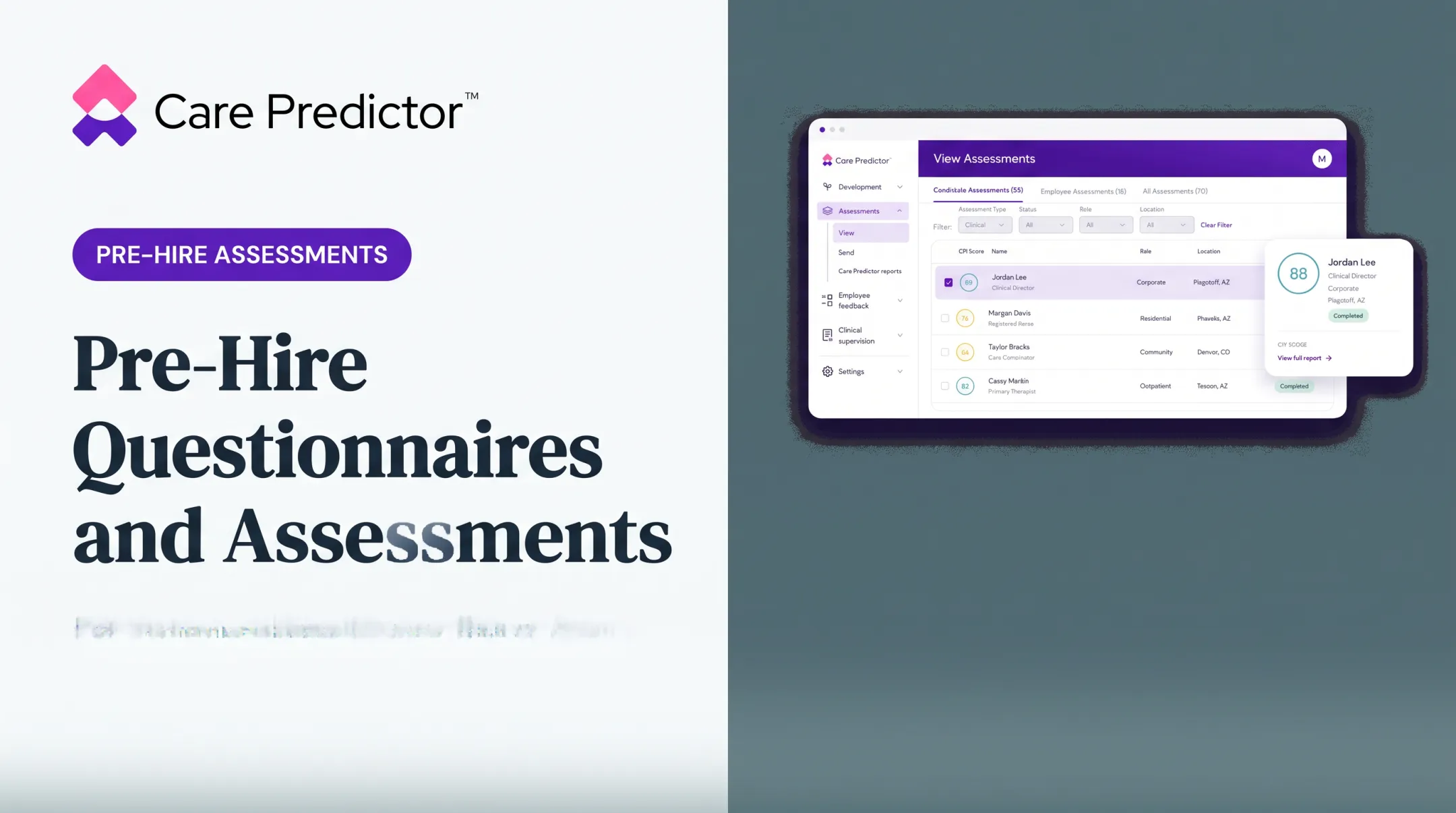
Care Predictor supports this process without replacing it. The Pre-Hire Care Profile Assessment scores candidates across 24 research-verified behavioral attributes, and ASSESS pairs that data with structured interview tools so teams keep human judgment in the loop.
The point is clearer signal before the offer—not an automated yes-or-no.
Applying Values-Based Assessments in Behavioral Healthcare
Values translate differently depending on the role. A values profile built for clinical staff won't fit a front-desk coordinator, and treating them identically is a common design mistake.
Mapping Values to Hiring Signals
- Compassion → patient-centered communication during intake and crisis
- Integrity → ethical documentation and confidentiality under pressure
- Accountability → follow-through on treatment plans and tasks
- Collaboration → coordination during handoffs and staffing gaps
- Continuous growth → engagement with supervision and feedback
Role-Specific Examples
- Counselors and clinical staff: scenario questions on de-escalation and relapse response
- Peer support workers: judgment around personal disclosure and boundaries
- Case managers: coordination across family communication and treatment-plan updates
- Technicians: consistency in following safety protocols under time pressure
- Administrative staff: accuracy and discretion handling sensitive records
A 2023 National Council for Mental Wellbeing survey of 750 US behavioral health workers found 93% reported some level of burnout, with 62% describing it as moderate or severe. That's a burnout signal, not a turnover statistic—and a reason to hire for resilience and fit before day one, not after problems surface.

Beyond the Hire
Assessment data doesn't have to stop at onboarding. Teams use it to shape manager coaching, professional development plans, and retention conversations. Care Predictor, for example, carries assessment signals from pre-hire screening into onboarding and engagement surveys, so teams can spot attrition risk in lifecycle check-ins before someone decides to leave.
Tie measurement plans to goals like staff satisfaction and team stability. Treat links carefully: association isn't causation. Research on clinician turnover and patient outcomes is mixed across studies, so avoid promising direct cause-and-effect from one tool.
Define values with clinical leaders, HR, compliance, and frontline staff—and revisit whether the assessment still matches real job demands.
Limitations, Fairness, and Safeguards
Values-based hiring can go wrong fast if the values themselves are vague or the process substitutes personal comfort for job relevance.
Common Failure Points
- Subjective "culture fit" judgments that reward interviewer resemblance over job performance
- Inconsistent interview questions across candidates
- Overly narrow "ideal employee" profiles that exclude qualified people
A well-known 2012 sociology study observed that interviewers often treated shared hobbies and self-presentation as evidence of fit, letting cultural similarity outweigh qualifications after initial screening. That's the exact trap a documented, behavior-based rubric is designed to avoid.
What to Never Screen For
Keep questions tied strictly to documented job behaviors. Never use a values test to probe:
- Personal religion or political beliefs
- Lifestyle choices unrelated to job performance
- Disability status
- Cultural conformity
Measurement Concerns to Watch
- Faking and social desirability in self-report formats
- Test-retest reliability and construct validity of any instrument used
- Accessibility across language differences and disability accommodations
- Context-free scoring, meaning a number without explanation of what it actually measures
Run a Fairness Review
Under federal guidelines, a selection rate for any group below four-fifths (80%) of the highest group's rate is a signal of potential adverse impact, though it's a screening guideline, not proof of legality on its own.
Review the process on a regular cadence:
- Selection-rate differences across groups
- Accommodation requests and how they were handled
- Candidate feedback on the assessment experience
- Whether scores add job-related signal rather than noise

Tell candidates up front:
- Why the assessment exists
- How their responses are handled
- Whether a human reviews results
- How to request accommodations
Used this way, values-based assessment supports clearer hiring decisions while keeping evaluation tied to the work, not a bare score.
Frequently Asked Questions
What is a values-based assessment?
A values-based assessment is a structured evaluation of job-relevant values and behaviors, scored against defined criteria. It should complement—not replace—competencies, experience, and structured interviews.
What are the 7 principles of assessment?
There's no universal seven-principle framework for hiring. The commonly cited version comes from Jisc's educational assessment guidance, not workplace selection. For US hiring, rely on SIOP's Principles for Personnel Selection and the EEOC's Uniform Guidelines.
How do values-based assessment tests work?
Candidates respond to work scenarios, behavioral questions, rankings, or questionnaires. Responses are scored against job-related criteria defined in advance, ideally with behavioral anchors.
Can a values-based assessment predict job performance?
Predictive value depends on the specific instrument, the role, how it's administered, and the validation evidence behind it. No test should be treated as a guarantee or used as the sole hiring decision.
How can employers use values-based assessments fairly?
Start with a job analysis, define behavior-based criteria, administer the tool consistently, and validate results. Offer accommodations, keep human review in the loop, protect privacy, and monitor adverse impact over time.