Predictive staffing analytics flips the sequence. Instead of reacting to a resignation letter, leaders use workforce and operational data to anticipate hiring, retention, and capacity needs before they become emergencies. This article covers what predictive staffing analytics actually means, how it supports hiring and retention decisions, a practical framework for behavioral health organizations, implementation steps, and the governance guardrails that keep it responsible.
Key Takeaways
- Predictive staffing analytics turns historical and current workforce data into early signals for hiring, onboarding, and retention decisions.
- The strongest programs connect hiring, engagement, and care outcomes instead of treating staffing as a one-time recruiting task.
- Models should inform, not replace, manager judgment, candidate conversations, and documented human review.
- Data quality, privacy, and ongoing validation determine whether a prediction is trustworthy enough to act on.
What Is Predictive Staffing Analytics?
Analytics generally progresses through four stages: what happened (descriptive), why it happened (diagnostic), what might happen next (predictive), and what action to take (prescriptive). Predictive staffing analytics belongs in that third stage.
It uses historical and current workforce data, statistical analysis, and sometimes machine learning to estimate likely outcomes. Examples include who might leave, which roles will be hardest to fill, or where a new hire may struggle.
That's different from workforce analytics as a whole. Workforce analytics is the broader practice of collecting and analyzing employee and applicant data to understand patterns and inform decisions.
Predictive staffing analytics is the forward-looking slice of that work. SHRM's 2023 article describes predictive analytics as tools and methods for forecasting future workforce events from large historical datasets.
Data inputs that may feed a model include:
- Hiring funnel activity and role requirements
- Tenure, absenteeism, and turnover history
- Engagement feedback and training progress
- Performance indicators and current staffing levels
- Relevant service-demand or census patterns
Three Distinct Applications, Not One Model
Leaders often lump these together, but they answer different questions:
- Demand forecasting estimates future staffing requirements based on expected workload or service volume.
- Predictive hiring evaluates which candidate attributes or assessment results correlate with later success in a specific role.
- Retention-risk analysis flags patterns associated with disengagement or possible turnover, without labeling any individual employee as a lost cause.
Before touching any of these, define the actual business or care question you're trying to answer. "Reduce time-to-fill for residential counselors" is a question a model can help with. "Make staffing better" is not.
How Predictive Staffing Analytics Supports Workforce Decisions
Once the question is clear, predictive analytics earns its keep across three connected areas of the employee lifecycle.
Workforce planning gets sharper when leaders can see recurring staffing patterns: which roles are chronically hard to fill, how seasonal or service-demand shifts affect capacity, and where current staffing doesn't match organizational goals.
Hiring decisions improve when organizations compare job requirements, structured assessment results, and interview data against actual later employment outcomes. This matters: a model should supplement structured human review, not make the hiring call on its own.
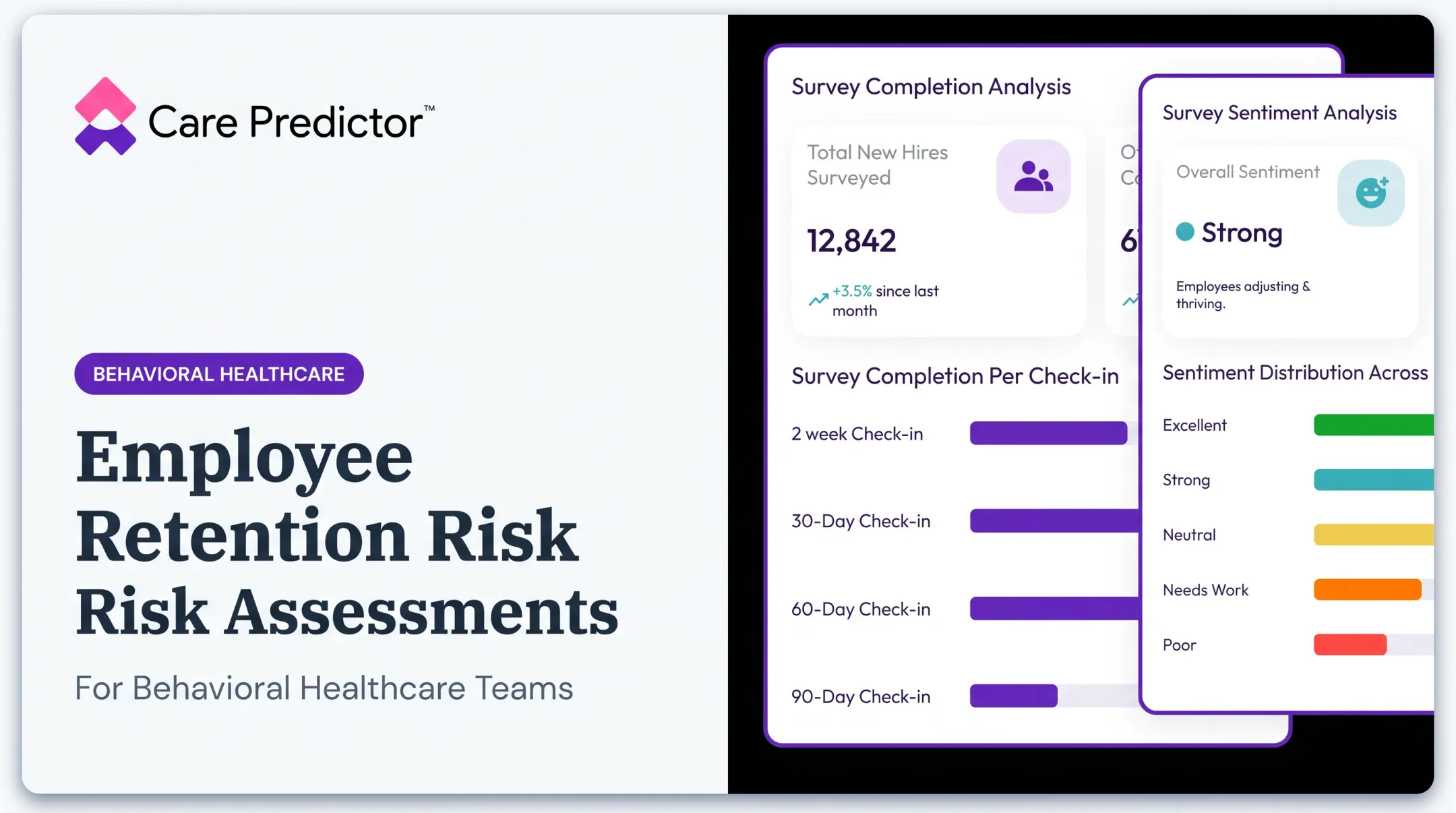
Onboarding and development benefit from early signals too. If data shows where new hires typically need extra support, training, or supervision during their first weeks, managers can intervene before a struggling new hire becomes a departure. Care Predictor's platform, for example, runs onboarding pulse checks at 2 weeks, 30 days, 60 days, and 90 days, surfacing where a new clinician may need coaching long before a 90-day review would catch it.
Why Staffing Stability Matters for Care Outcomes
Retention isn't just an HR metric in behavioral health. A prospective study following 328 clients and 121 clinicians across two community behavioral health centers found that 24% of clients experienced a clinician change over 12 months, according to Knudsen's 2020 study.
The effect wasn't uniform. Turnover coincided with clinical decline for some client groups, but was associated with improved mental-health functioning for clients with very low baseline functioning. Continuity is a risk signal worth tracking and segmenting, not a blanket rule that turnover is always harmful.
Use this simple decision framework when a prediction surfaces:
- Identify the workforce question the data should inform.
- Review the relevant data and its limitations before trusting the output.
- Compare the model's insight with employee, manager, and clinical context.
- Take a documented action, not a silent one.
- Monitor whether that action actually improved the outcome you targeted.

A Practical Predictive Staffing Analytics Framework for Behavioral Health
Building a useful program starts with mapping the employee lifecycle, not buying software.
Map the lifecycle stages:
- Candidate attraction and assessment
- Hiring and onboarding
- Engagement and ongoing development
- Retention and, eventually, exit
Each stage supports different analytics use cases, so decide which decisions actually need a model before you start pulling data.
Define outcomes before you build anything. What counts as a "successful" onboarding? A stable team? A quality hire? Write measurable definitions for turnover, team stability, staff satisfaction, and care continuity before a single dashboard gets built.
Audit Your Data Foundation First
Most predictive programs fail quietly here. Check for:
- Completeness and consistency across locations or programs
- Timeliness of updates
- Duplicate records and missing fields
- Inconsistent role names between systems
Pair quantitative records (assessments, tenure, turnover history) with qualitative evidence: exit interviews, manager observations, and frontline feedback. Numbers without context mislead.
Leading indicators worth watching:
- Engagement dips
- Missed training milestones
- Workload complaints
- Unresolved manager feedback
Lagging indicators to track:
- Turnover
- Vacancy duration
- Quality-of-hire outcomes
- Treatment continuity
Pick metrics tied to a defined decision, not ones that are simply easy to export.
A residential program notices repeated turnover among first-year counselors on one unit. Historical hiring and engagement data points to a gap in early supervision hours.
Leadership adds a structured mentoring check-in during the first 60 days, then compares turnover and engagement scores over the following cycles before deciding whether to expand it. That's the loop: identify, test, compare, adjust.

How to Implement Predictive Staffing Analytics
Don't try to model every workforce outcome in month one. Start with a focused pilot, such as improving retention for one specific role or program.
Before launch, align these groups on the purpose and the decisions the initiative will support:
- Executives and HR leadership
- Operations and clinical leadership
- Data owners, managers, and frontline staff
Then inventory the systems involved, assign data ownership, set access controls, and establish a process for correcting bad records. Choose analytical methods based on your organization's data maturity, explainability needs, and ability to fit insights into existing workflows, not based on whichever vendor has the flashiest demo.
Where a Workforce Intelligence Platform Fits
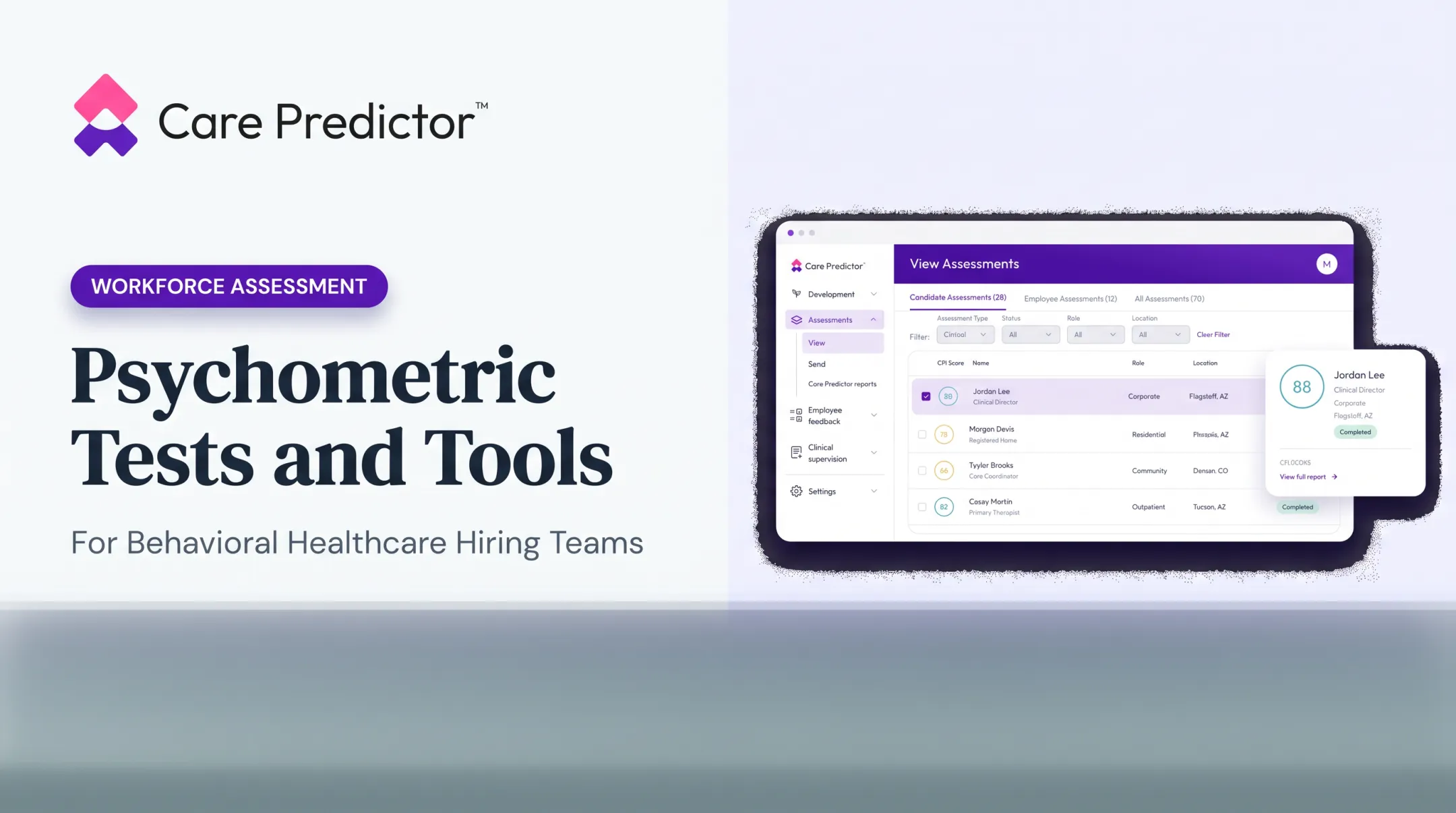
Care Predictor is a relevant example of a behavioral-health-specific workforce intelligence platform. Its Talent Success Platform combines three pieces: ASSESS evaluates candidates, INTERVIEW keeps interview information in one place, and PREDICT delivers objective, data-driven candidate insight. The platform doesn't require EMR or EHR integration to start, and it can become operational within about a week. Entry-level access starts at $499 per month on the Hire & Keep plan, with custom pricing for larger organizations.
Build an adoption and review cycle:
- Train leaders to read predictions as signals and probabilities, not certainties.
- Give decision-makers clear recommended actions and escalation paths.
- Collect feedback from users and the staff affected by the decisions.
- Reassess the model as workforce conditions shift.

Before launch, define your evaluation plan: a baseline, target outcomes, a comparison period, an implementation owner, a review cadence, and clear criteria for expanding or stopping the pilot.
Responsible Use, Governance, and Measurement
Predictive models carry real risk if left unchecked: biased historical data, proxy variables that mirror protected characteristics, weak data quality, opaque recommendations, and overreliance on a score instead of a conversation.
Governance safeguards worth building in:
- Data minimization and role-based access
- Documented model purpose and ongoing bias review
- Explainability for every recommendation
- Human approval before any employment action
- Employee feedback channels and periodic validation
Federal anti-discrimination law applies to AI-assisted hiring tools the same way it applies to any other employment practice. Several states and cities now require notice or bias audits before automated tools are used in hiring.
Predictions should never serve as the automatic grounds for rejecting a candidate, disciplining staff, or denying a development opportunity. Context, evidence, and human review still matter.
Care Predictor's own privacy principles reflect this: purpose limitation, data minimization, accuracy, and accountability, backed by ISO 27001:2022 certification. The company's pre-hire guidance is explicit that hiring managers should treat the assessment as an additional resource, not a replacement for reviewing a candidate's actual qualifications.
Governance only holds if you measure results. A simple scorecard keeps the program honest:
| Category | Example Metrics |
|---|---|
| Workforce | Retention, vacancy duration, time-to-fill, onboarding completion, engagement |
| Care & organizational | Treatment completion, patient retention, continuity of care, productivity |
| Quality | Data completeness, model calibration, false positives/negatives, adoption, trust |
From Reactive Staffing to Evidence-Informed Workforce Decisions
Predictive staffing analytics works best as a shift in habit, not a one-time software purchase. It moves behavioral health leaders from reacting to vacancies toward anticipating workforce needs and fixing the root cause instead of the symptom.
Care Predictor builds its platform around that same principle: combining behavioral science, scientific rigor, and modern data analytics to help organizations make more informed hiring, engagement, and retention decisions, without losing the human connection that care work depends on. The technology is meant to strengthen that connection.
Your next step doesn't require a new vendor. Start small:
- Pick one workforce question
- Audit the data you already have
- Involve the managers and staff the decision will affect
- Run one measurable pilot before you scale
Frequently Asked Questions
What are the top 5 analytics tools?
The right tool depends on your use case, existing systems, and data maturity. General business intelligence platforms, HR analytics tools, applicant tracking systems, and specialized workforce intelligence platforms serve different needs, so match the tool to the decision, not a generic ranking.
What is workforce analytics?
Workforce analytics is the collection and analysis of employee, hiring, and operational data to understand patterns and improve decisions. Predictive staffing analytics is its forward-looking branch, focused specifically on anticipating future staffing conditions or outcomes.
How does predictive staffing analytics help behavioral health organizations?
It supports workforce planning, candidate assessment, onboarding, and retention efforts, while helping leaders spot risks to team stability and staff satisfaction early. Workforce decisions also connect to continuity of care, so staffing stability deserves attention beyond HR metrics.
What data is needed for predictive staffing analytics?
Useful data includes role and hiring records, tenure and turnover history, engagement feedback, training progress, staffing levels, and relevant service-demand information, plus clearly defined outcomes. That data needs to be accurate, relevant, secure, and lawfully collected.
Can predictive analytics replace human judgment in hiring and workforce decisions?
No. Analytics should support, not replace, structured human judgment, clinical and operational context, candidate conversations, and fairness review. Every prediction still needs a documented, human-reviewed decision behind it.