Behavioral health and addiction treatment providers feel this acutely. A National Council survey found that 93% of behavioral health workers experienced burnout in 2023, and 48% had considered other employment because of workforce shortages. Unstable staffing doesn't just strain your payroll. It disrupts caseloads, therapeutic relationships, and treatment continuity.
This article walks through how to calculate turnover that actually means something, trace it to its root causes, build targeted retention measures, and confirm whether those measures worked.
Key Takeaways
- Turnover analysis beats a single percentage by exposing patterns across role, manager, location, and reason for leaving
- Separating voluntary, involuntary, regrettable, and preventable turnover changes which action makes sense
- Pairing HR data with stay interviews, exit interviews, and pulse surveys explains what the numbers mean
- Retention tactics only work when matched to the root cause, whether that's workload, onboarding, or pay
- Predictive tools should support human conversations, never replace them
Common Causes of Employee Turnover
What Is Employee Turnover Analysis?
Employee turnover analysis is the systematic collection and interpretation of departure data to figure out who leaves, when, why, and what your organization can realistically change. It's broader than tracking "attrition," which usually refers to positions left unfilled rather than people who quit.
A reliable analysis layers four things together:
| Layer | What It Does |
|---|---|
| Descriptive | Reports what happened (rates by month, role, location) |
| Diagnostic | Investigates why it happened |
| Predictive | Flags early warning signs before someone resigns |
| Prescriptive | Recommends a specific, targeted action |
Before you calculate anything, split overall turnover into voluntary and involuntary categories. Then go further: regrettable departures (your best people), preventable departures (fixable causes), and strategically beneficial departures (a role or person that genuinely needed to go). Treating all exits the same hides where the real problem lives.
Cause 1: Burnout, Workload, and Insufficient Support
Emotionally demanding work, understaffed shifts, unpredictable schedules, and overtime wear clinicians down fast. A National Council survey found 62% reported moderate or severe burnout, and 65% said their caseload had increased since the pandemic.
Don't assume burnout explains every exit. Test it against:
- Overtime and absenteeism trends by team
- Caseload size relative to tenure
- Pulse-survey sentiment scores before departures
- Exit-interview themes mentioning workload specifically
Care Predictor's engagement platform runs AI sentiment analysis on pulse-survey comments and flags retention risk early, before strain turns into an open position.
Cause 2: Manager Effectiveness and Team Climate
Inconsistent supervision and poor communication push people out the door quietly. Gallup's 2024 research on employees who recently quit found that 42% said their manager or organization could have prevented their departure, and 45% had no proactive conversation about their satisfaction or future in their final three months.
Compare turnover across managers and teams, but control for shift, caseload, and location first. A high-turnover unit on the overnight detox shift isn't automatically a management failure.
Review:
- 1:1 frequency and stay-interview themes
- Engagement-survey items tied to recognition and support
- Internal complaints and team-level turnover trends
Pulse-survey insights, when fed back to supervisors consistently, support exactly this kind of manager development and accountability.
Cause 3: Hiring, Role Fit, and Onboarding Gaps
Unclear job expectations and weak onboarding create early-tenure turnover before a new hire ever gets comfortable. Healthcare-wide data consistently shows roughly a quarter of newly hired clinical staff leave within their first year. That is why tracking new-hire turnover by cohort matters as much as overall turnover.
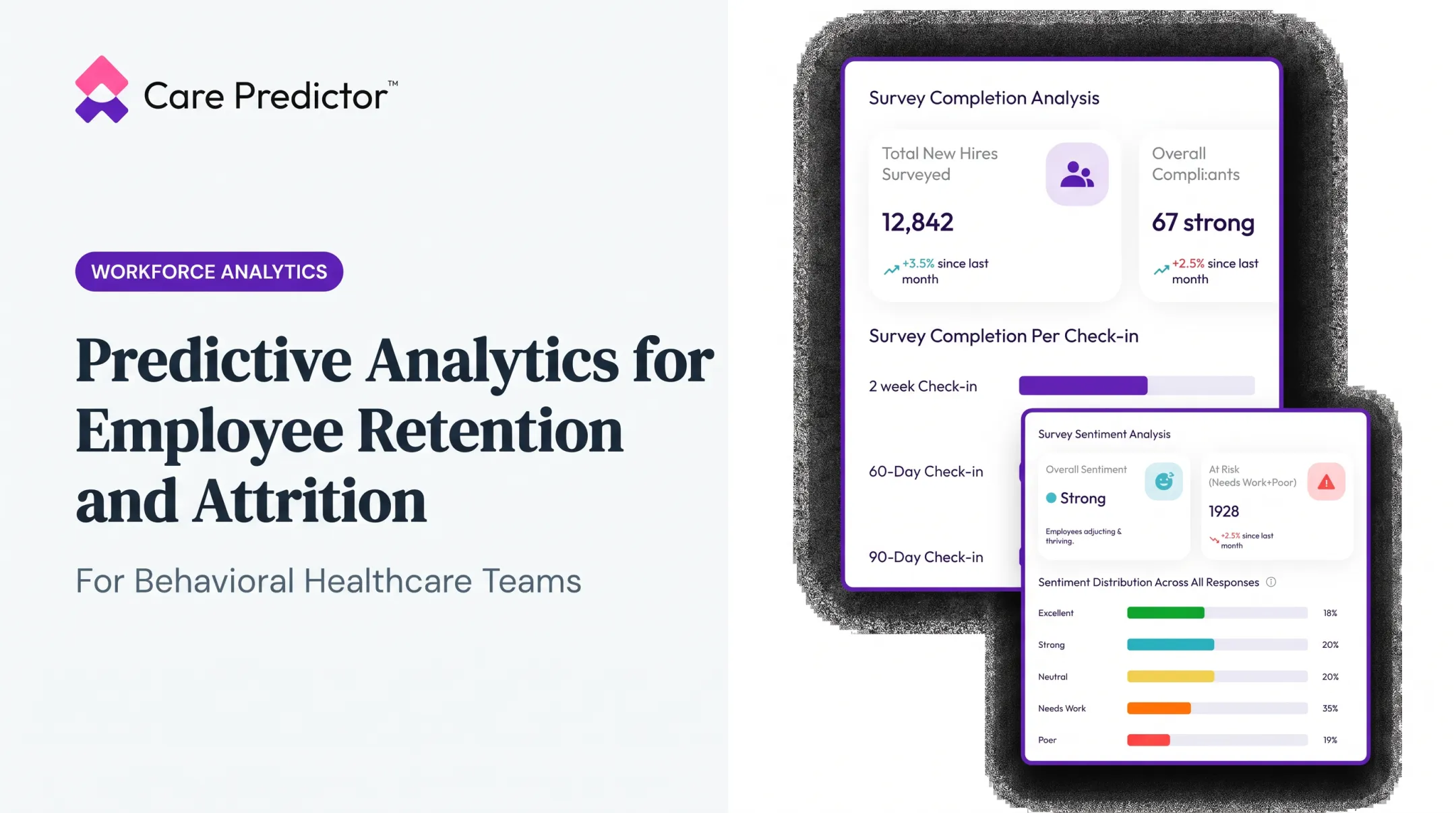
A useful early-tenure benchmark comes from new-hire survey completion rates themselves. On Care Predictor's platform, completion drops from 92% at two weeks to 54% at 90 days across 12,842 surveyed new hires. That drop is worth investigating when it shows up in your organization.

Pre-hire assessment helps here too. Care Predictor's Pre-Hire Care Profile evaluates candidates across 24 research-verified attributes, giving hiring managers an objective read on fit alongside their own judgment, not instead of it.
Cause 4: Compensation, Career Growth, and Employee Experience
Pay matters, but it's rarely the only factor. BLS wage data puts the median pay for substance abuse and mental health counselors at $59,350 annually, with residential-facility counselors earning less, around $49,660, than hospital-based counselors at $63,310.
Segment departures by:
- Pay band and role
- Tenure and promotion history
- Training participation versus no development activity
- Stated reason for leaving
If exits cluster among staff with no training history or promotion path, a pay bump alone won't fix it. Career development tools, like built-in learning plans tied to each employee's Care Profile, address the growth gap directly.
What Happens If Employee Turnover Is Ignored
Unaddressed turnover compounds. Each departure triggers recruiting costs, vacancy time, overtime for remaining staff, and lost institutional knowledge. The people who stay absorb the extra workload, which often accelerates the next resignation.
In behavioral health settings, the stakes go beyond cost. Disrupted therapeutic relationships and inconsistent care teams can affect treatment continuity.
A validated internal study of 7,325 treatment episodes across five behavioral health organizations found that therapists scoring 80 or higher on the Care Predictor Index completed 25% more treatments and had 29% fewer patients leave against medical advice, compared to lower-scoring peers. Staff stability and care outcomes move together.

Build an organization-specific cost model that includes:
- Recruiting and advertising spend
- Temporary or agency coverage
- Overtime paid to cover vacancies
- Onboarding and training hours
- Lost productivity during ramp-up
- Treatment-completion or care-continuity indicators
Warning Signs You're About to Experience Preventable Turnover
Treat these as patterns to investigate, not proof any one employee is leaving.
- Rising absenteeism or overtime paired with workload complaints or declining participation in team activities
- Dropping engagement scores, especially on intent-to-stay, manager-support, or recognition items
- Resignation clusters tied to a specific manager, shift, site, tenure band, or new-hire cohort
- Repeated concerns surfacing in stay interviews, exit interviews, onboarding check-ins, or incident reports
How to Prevent Employee Turnover
Prevention works as a cycle: establish a baseline, find the highest-impact segment, validate the cause with employees, act, then measure the result.

Prevention Measure 1: Build a Consistent Turnover Measurement Framework
Define your measurement period, headcount denominator, and separation categories before calculating anything. Report overall, voluntary, involuntary, and new-hire turnover separately. Track results by role, department, manager, location, and tenure, but investigate small-group numbers carefully to protect privacy.
For example, a mid-sized treatment organization's turnover dashboard might show 145 active employees, 10 months average tenure, 7 exits over a quarter, and a 5% turnover rate, broken down by department and termination type. That level of detail makes the number actionable instead of just a headline.
Prevention Measure 2: Combine Workforce Data With Employee Feedback
Link HRIS records to engagement surveys, stay interviews, exit interviews, and scheduling data. Compare employees who stayed with those who left, but don't assume exit-interview answers represent your entire workforce.
AI-assisted sentiment analysis can read hundreds of open-text comments in seconds and surface recurring themes. Those themes often include cross-departmental communication gaps or limited in-person time with supervisors, and the process is far faster than reading every comment by hand.
Prevention Measure 3: Improve Hiring, Onboarding, and Early-Tenure Support
Set realistic expectations during recruitment and assess role-relevant behaviors before hiring, not just credentials. Build a structured onboarding plan covering supervision access, workflows, and escalation channels.
Schedule check-ins at 2 weeks, 30, 60, and 90 days, and treat drop-off in completion rates as a signal in itself. If completion falls sharply by day 90, that often points to unclear workload expectations or insufficient manager contact, not disengaged employees.
Prevention Measure 4: Target the Intervention to the Diagnosed Cause
Match the fix to what the data actually shows:
- Workload findings → staffing plans, schedule redesign, caseload review
- Manager findings → supervisor coaching, feedback routines, accountability
- Growth or pay findings → transparent career paths, pay-equity review, benefits analysis
Every intervention needs an owner, a timeline, a defined employee group, a success measure, and a follow-up date. Without those five elements, you still have a good intention rather than an executable plan.
Tips for Long-Term Prevention and Control
Sustained retention takes ongoing discipline, not a one-time fix.
- Maintain a recurring dashboard covering turnover by segment, new-hire retention, tenure distribution, and absenteeism
- Document your definitions, data sources, and reason-for-leaving categories so results stay comparable year over year
- Train managers to hold structured stay conversations and escalate issues they can't solve alone
- Validate predictive models on your own data, test for bias, and use results only to offer support, never for automatic employment decisions
A workforce intelligence platform like Care Predictor can support candidate assessment, onboarding, engagement, and retention in one place. That said, technology should strengthen human judgment and connection, not substitute for the conversations managers need to have with their teams.
Conclusion
Turnover follows patterns across the employee lifecycle, from how realistically a role was described during recruitment to how well a manager checks in six months later. None of it is random, so measure it carefully.
Effective retention starts with disciplined analysis and genuine investigation into what employees are telling you, then moves into targeted action and repeated measurement. Skip the diagnosis, and even well-funded retention programs miss the mark.
Workforce stability isn't a side issue for behavioral health organizations. It's tied directly to the continuity and quality of care patients receive, though no single metric or platform will eliminate turnover entirely. Consistent analysis gives you a clearer path to catch problems before they become resignations.
Frequently Asked Questions
What is considered a good employee turnover rate?
It depends on industry, role, and whether departures are voluntary, preventable, or strategically beneficial. Compare your results against relevant U.S. behavioral health benchmarks and, more importantly, your own historical trend.
What is employee turnover analysis?
It's the process of measuring and interpreting employee departures by category, timing, and workforce segment to identify causes and guide retention action. A single turnover percentage isn't analysis on its own.
How do you calculate employee turnover rate?
Divide separations during a period by average headcount for that same period, then multiply by 100. Calculate voluntary and involuntary rates separately since they point to different problems.
Which employee turnover metrics should HR track?
Track overall, voluntary, involuntary, preventable, regrettable, new-hire, department, manager, and tenure-based turnover, along with retention and vacancy metrics. Prioritize metrics that lead directly to an action.
How can behavioral health organizations reduce employee turnover?
Focus on realistic hiring, structured onboarding, manageable workloads, effective supervision, and competitive pay. Pair these with ongoing employee feedback and interventions targeted to what the data actually shows.
Is all employee turnover bad for an organization?
No. Some turnover is functional or unavoidable. But preventable departures of high-performing, experienced staff create disproportionate operational and care-continuity risks compared to routine attrition.