Introduction
Hiring the wrong clinician doesn't just cost money. It disrupts client relationships, overloads the rest of the team, and can stall treatment progress for people who are already in crisis.
In behavioral health, staff stability, role fit, and genuine compassion shape outcomes in ways most industries never have to worry about.
A 2023 survey of 750 mental health and substance use disorder workers found that 93% reported some level of burnout, and 48% said workforce shortages had made them consider leaving the field entirely. The National Council for Mental Wellbeing and Harris Poll frames a clear signal of strain across the workforce.
Predictive hiring analytics uses evidence from past hiring and workforce outcomes to support more consistent decisions about candidate fit and retention likelihood. It doesn't replace recruiters or hiring managers—it gives them better information to work with.
This guide covers what predictive hiring analytics is, how it supports recruitment decisions, and what behavioral health leaders should weigh before adopting it.
Key Takeaways
- Predictive hiring analytics estimates future outcomes using historical candidate and workforce data, not guesswork
- The strongest systems pair validated assessments and structured interviews with human judgment
- Behavioral health teams can apply it to fit, onboarding, engagement, and retention planning
- Fairness, privacy, and ongoing validation protect both candidates and the organization
- Success is measured by quality of hire and retention, not by the model's sophistication
What Is Predictive Hiring Analytics?
Predictive hiring analytics applies statistical and machine-learning methods to historical recruitment, assessment, and employee data to estimate future outcomes. That might mean the likelihood a candidate succeeds in a specific role, how long they'll stay, or whether they'll accept an offer.
It goes well beyond resume screening or keyword matching. A properly built system can incorporate structured interview responses, validated behavioral assessments, onboarding completion rates, performance indicators, and tenure data collected with appropriate consent.
Descriptive, Predictive, and Prescriptive Analytics Aren't the Same Thing
These terms get used interchangeably, but they answer different questions:
- Descriptive analytics reports what already happened, such as last year's turnover numbers
- Predictive analytics forecasts what's likely to happen next, such as which candidates are statistically more likely to stay
- Prescriptive analytics recommends what action to take based on that forecast
Knowing which type you need is only half the job. Technical sophistication doesn't replace validation—a machine-learning model with elegant architecture is worthless if it was trained on biased or incomplete historical data.
Job-Relevant Predictors vs. Proxies
This distinction matters more than almost anything else in this field:
- Job-relevant predictor measures something directly tied to role performance, such as communication style under pressure or reliability in follow-through
- Proxy infers suitability from something irrelevant, like a candidate's background, zip code, or personal identity
Care Predictor's Pre-Hire Care Profile Assessment, for example, evaluates candidates across 24 research-verified behavioral attributes tied to care delivery, not demographic shortcuts.
Across 7,325 treatment episodes studied over two years, therapists scoring 80 or above on their Care Profile completed 25% more treatments and lost 29% fewer patients to against-medical-advice discharges. That's an outcome tied to a measured, job-relevant signal.

Why Predictive Hiring Analytics Is Critical in Recruitment
Vacancies, burnout, and poor role fit don't stay contained to HR. They ripple into caseloads, team morale, and continuity of care. When a clinician leaves six months into the job, someone else absorbs their clients overnight.
Analytics improves decision quality by identifying which job-related behaviors and assessment signals have historically aligned with success in a specific role, rather than relying on gut instinct during a 30-minute interview.
The Efficiency Case
Hiring is expensive even when it goes right. SHRM's 2025 recruiting benchmark reports an average nonexecutive cost per hire of $5,475 and a median time-to-fill of 44 calendar days across U.S. industries, according to SHRM's 2025 benchmarking report.
Behavioral health organizations managing clinical and support roles across multiple locations feel that cost acutely. A bad hire often means repeating the full process within months.
Where the cost shows up fastest:
- Repeating recruiting spend when a clinician exits early
- Covering caseloads while seats stay open for weeks
- Losing continuity of care as clients are reassigned overnight
- Stretching remaining staff and accelerating burnout risk
Structured, consistent data can reduce avoidable subjectivity in screening. It cannot eliminate bias on its own—which is why the risks below matter as much as the efficiency gains.
Risks and Limitations You Can't Ignore
Predictive systems carry real risk if built or monitored carelessly:
- Biased historical data bakes past inequities into future scores
- Small sample sizes yield unreliable predictions for less common roles
- Model drift leaves older models out of step with current labor markets
- Single-score overreliance replaces judgment instead of supporting it
Federal law already applies. The EEOC has clarified that existing employment discrimination laws apply to AI-assisted hiring tools. A seemingly neutral scoring system can still be unlawful if it creates a disparate impact on a protected group.
Several states—including Illinois, Colorado, and California—add notice and audit requirements for automated hiring tools. HR teams adopting these systems need to treat that guidance as mandatory, not optional.
Candidate consent, data minimization, documented decision rules, and human review aren't bureaucratic extras. They're what keeps a predictive system defensible.
How Predictive Hiring Analytics Works – Step by Step
Predictive hiring analytics is a repeatable process, not a one-time software purchase. Organizations typically fail when they skip outcome definition, data validation, or post-hire follow-up.
Step 1: Define the Objective
Specify exactly what you're predicting, whether that's early turnover, success in a specific care role, or offer acceptance. Vague goals like "culture fit" produce unusable models. Define the target outcome, timeframe, and decision point up front.
Step 2: Gather Inputs
Pull job-relevant inputs from sources such as:
- Job analyses and role requirements
- Structured interview responses
- Validated pre-hire assessments
- Onboarding measures and tenure data
Separate that information from sensitive personal data, and be explicit about consent and retention limits.
Step 3: Organize and Prepare
Clean and standardize the data. Check whether historical hiring decisions reflect unequal access, inconsistent interview practices, or shifting job requirements before trusting that data to train anything.
Step 4: Apply the Analysis
Match the statistical method to the outcome, available data, and need for interpretability. Validate against a simple baseline (for example, current screening rules) and compare performance across roles and relevant candidate groups. Frame the output as a probability or prioritization signal, not a certainty.
Step 5: Interpret Results
Translate the model's output into practical checks:
- What evidence supports this signal?
- Is it relevant to the role?
- Could a human reviewer reasonably challenge it?
Hiring teams should combine analytics with structured interviews and candidate context, not treat a score as the final word.
Step 6: Act and Review
Close the loop with three ongoing actions:
- Refine sourcing, interview design, and onboarding based on what the model surfaces
- Compare predicted outcomes with actual post-hire results at set checkpoints
- Run governance reviews for fairness, model drift, and changes in the care environment

Predictive Hiring Analytics – Example Case Walkthrough
Here's an illustrative example of how this process plays out. It doesn't represent a specific Care Predictor customer or guaranteed result.
A multi-location behavioral health provider wants to improve hiring and retention for a high-volume direct-care role. Annual turnover in roles like this commonly runs 30-40%.
Leadership sets a clear objective: identify which job-related signals are associated with successful onboarding and sustained employment, then establish a baseline against current outcomes.
The team gathers the data they need:
- Role requirements
- Structured interview and assessment results
- Onboarding completion data
- Manager feedback
- Later employment outcomes
They strip out irrelevant or sensitive variables and check for gaps in the data.
Applying the Model and Avoiding Common Mistakes
Once the model identifies signals associated with the target outcome, the team reviews whether those signals are understandable and genuinely job-related, not just statistically convenient. A trained human reviewer makes the final call on every hire.
Common mistakes teams should watch for:
- Treating correlation as causation ("this trait appeared in successful hires" doesn't always mean it caused success)
- Using too little data to draw reliable conclusions
- Confusing candidate availability with long-term commitment
- Ignoring candidate experience during a longer, data-heavy process
- Never checking whether predictions actually matched real outcomes
The team then refines interview questions, onboarding support, and manager coaching based on what they learned. They compare future outcomes against the original baseline.

How Care Predictor Can Help
Care Predictor is a behavioral-health workforce intelligence platform that combines behavioral science with data analytics, helping treatment providers make more objective, evidence-based talent decisions. It covers assessment, interviewing, prediction, onboarding, and engagement across the full employee lifecycle.
What the Platform Actually Does
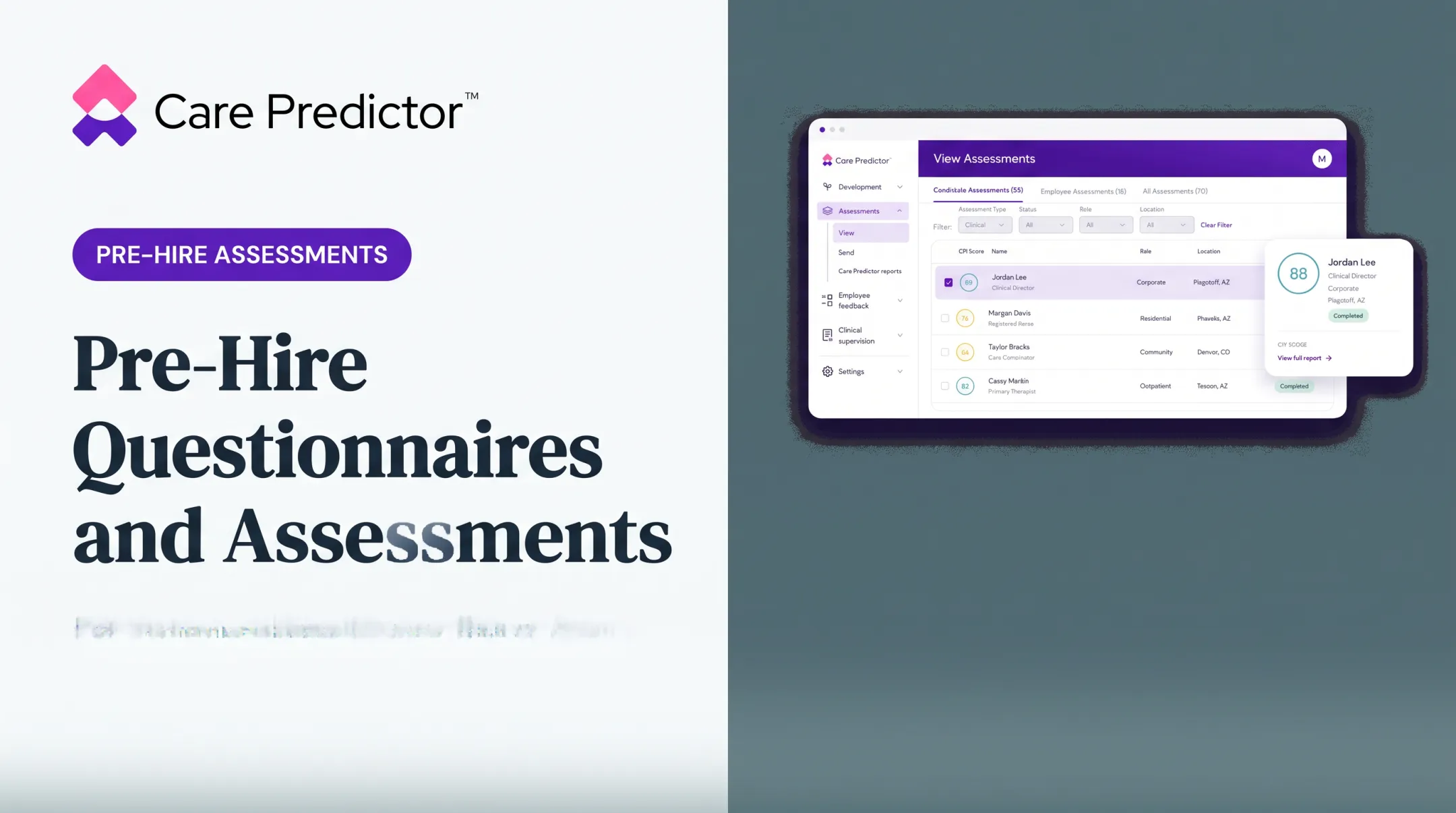
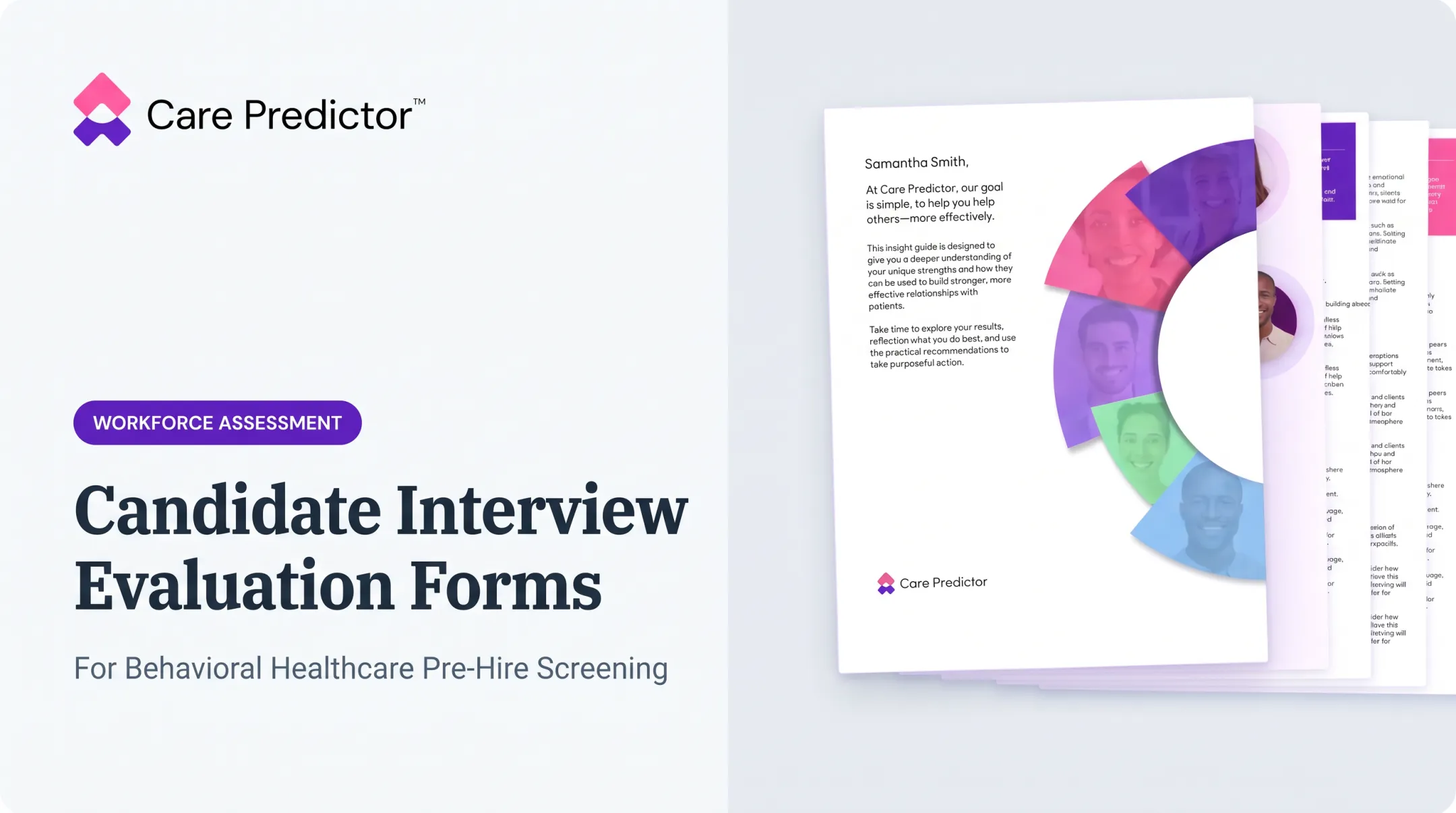
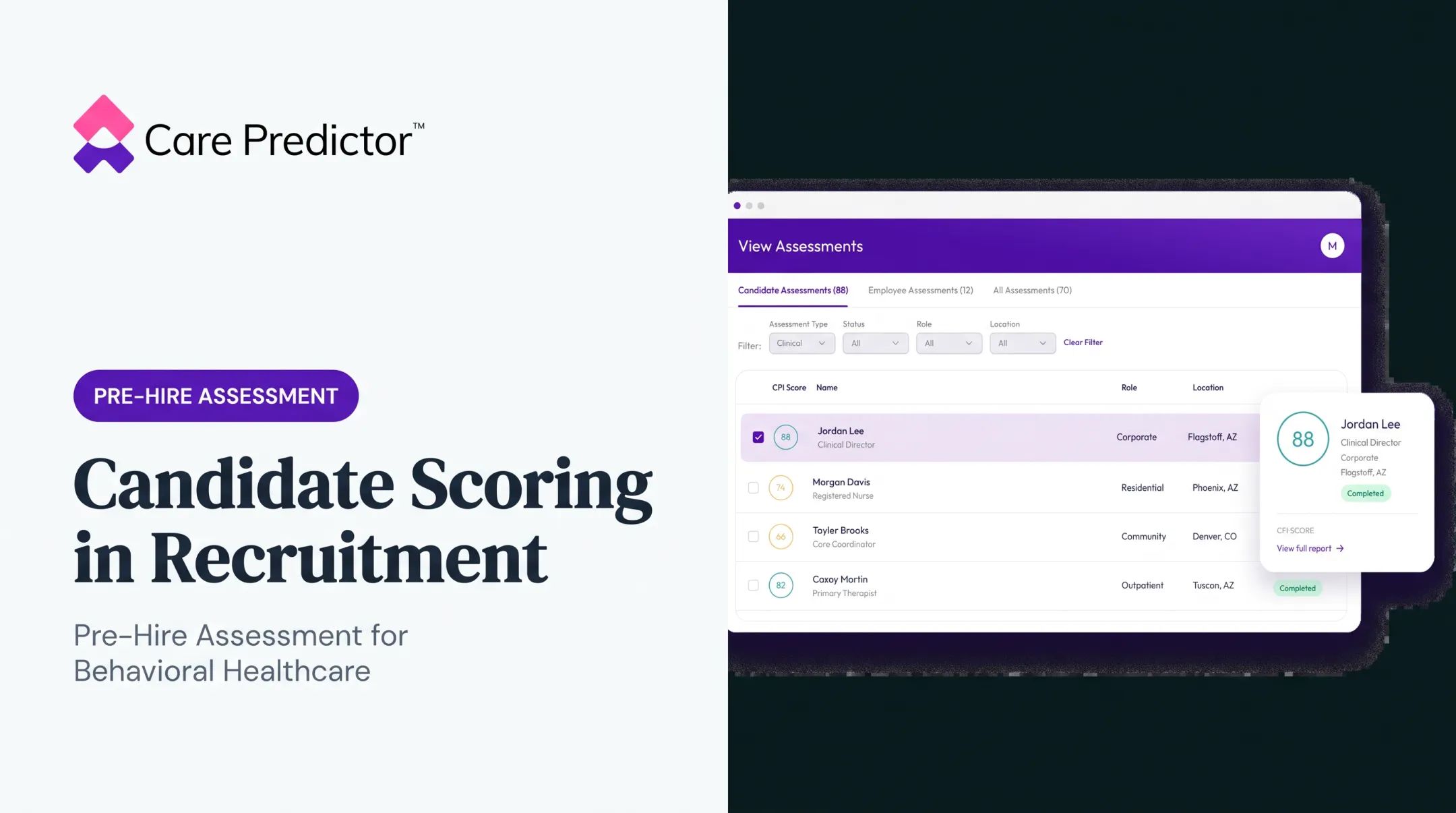
- Pre-Hire Care Profile Assessment evaluates candidates across 24 research-verified behavioral attributes, producing a candidate fit dashboard and role-specific interview guides
- Candidate Alignment reporting shows an 89% candidate score for role and team fit alongside a 31% average reduction in time-to-fill
- Employee Care Profile & Development Platform tracks onboarding pulse checks at 2-week, 30-day, 60-day, and 90-day intervals, plus eNPS and sentiment data
- Reporting & Analytics dashboards connect workforce, treatment outcome, census, and turnover data in one place, filterable down to an individual staff member
Those capabilities show up in measured outcomes. Across 30 therapists at four treatment centers, higher Care Profile scores correlated with treatment completion, client satisfaction, and lower AMA rates.
Care Predictor is used by more than 100 behavioral health organizations, with employee surveys that can launch within seven days of signup and no EMR integration required.
On the security side, Care Predictor holds ISO 27001:2022, SOC 2, PCI-DSS 4.0, and NIST Cybersecurity Framework credentials. These frameworks address data security and operational controls. They don't by themselves guarantee compliance with every employment or privacy law in every state, which is why human review and documented decision rules still matter.

If your organization manages hiring and retention across multiple locations, review your hiring, engagement, and retention data with Care Predictor's team to see where the gaps actually are.
Conclusion
Predictive hiring analytics gives behavioral health recruitment teams something they've rarely had. It connects hiring inputs to outcomes like role fit, retention, and team stability, backed by evidence instead of instinct.
None of that works without valid data, job-related measures, and a human reviewer accountable for the final call. The organizations getting real value from this approach treat it as ongoing practice, not a one-time tool rollout.
Better hires, stronger engagement, and better patient outcomes all depend on support that starts before the hire and continues long after onboarding ends.
Frequently Asked Questions
What does predictive hiring mean?
Predictive hiring uses historical candidate and employee data to estimate the likelihood of future job-related outcomes, such as retention or role success. The final decision always rests with qualified human reviewers.
Can AI do predictive analytics?
Yes, AI and machine-learning systems can identify patterns and generate predictions. However, they require relevant data, ongoing validation, fairness monitoring, and human oversight to be used responsibly.
Which tool is best for predictive analytics?
The right tool depends on your goals, data quality, role types, and security requirements. Care Predictor serves behavioral health organizations that need predictive hiring for clinical roles.
What are examples of predictive analytics?
Common recruitment examples include estimating time-to-fill, identifying candidates likely to succeed in a role, forecasting offer acceptance, and flagging retention risk. These are probability-based estimates, not guarantees.
What are the four types of HR analytics?
Descriptive analytics reports what happened, diagnostic explains why, predictive forecasts future risk, and prescriptive recommends the next action.
Is AI taking over talent acquisition?
AI can automate parts of sourcing, screening, and forecasting, but it hasn't replaced human judgment. Relationship-building, context, and accountability still require human judgment in the process.