For behavioral health and addiction treatment providers, this matters more than in most industries. A single hiring decision affects team stability, staff satisfaction, patient retention, and whether a client completes treatment. In a 2023 survey of 750 U.S. mental health and substance use treatment workers, 93% reported experiencing burnout and 48% said workforce shortages had made them consider leaving their jobs.
This guide covers what candidate scoring actually is, how to build a scorecard that holds up under scrutiny, where it goes wrong, and when a simpler process is the better choice.
Key Takeaways
- Candidate scoring converts role requirements and interview evidence into comparable evaluations.
- Start from a clear success profile, not an arbitrary point scale or keyword count.
- Structured interviews, calibrated scorecards, and documented evidence reduce inconsistent evaluations.
- Scores inform recruiter and clinical leadership judgment on empathy and teamwork; they do not replace it.
What Is Candidate Scoring in Recruitment?
Candidate scoring is the practice of rating, ranking, or categorizing applicants against predefined competencies, qualifications, behaviors, and role requirements. The goal is simple: help hiring teams identify who merits further review, an interview, or an offer, using the same standards for every applicant.
It's often confused with related tools that do something different:
- Resume parsing extracts information from an application. It doesn't evaluate anything.
- Knockout questions identify minimum requirements, like a license or certification. They screen out, not in.
- Interview scorecards record one evaluator's ratings for one conversation.
- Predictive models estimate the likelihood of a defined outcome, such as retention or performance, based on historical patterns.
Candidate scoring sits above all of these. It's the framework that pulls evidence from each source into one comparable picture.
Why It Matters in Behavioral Health
Behavioral health roles rarely come down to credentials alone. A counselor or direct care worker needs technical capability, yes, but also emotional regulation, reliability, communication skills, and a genuine commitment to patient-centered care.
A credentials check won't tell you whether someone can de-escalate a crisis or sustain compassion through a 50-hour week.
Without a consistent process, a few things tend to go wrong:
- Interviewers score the same answer differently depending on personal preference.
- Standards drift across locations or hiring managers.
- Rushed decisions overlook qualified applicants who interview less smoothly.
- New hires struggle with burnout or team fit within the first few months.
The scale of the problem is well documented. SAMHSA has found that staff turnover in the substance use treatment field runs as high as 50% annually, and Care Predictor's own client data puts typical annual turnover in behavioral health at 30% to 40%.
Neither number proves that scoring alone fixes turnover. What those figures do show is why consistent, job-related evaluation is worth the effort when scarce interview time has to produce comparable evidence across every candidate.
Candidate scoring is an operational best practice, not a universal legal mandate. The criteria you select, how you document them, and how you handle candidate data still need to align with U.S. employment and anti-discrimination law. A scored interview isn't exempt from that scrutiny just because a human assigned the number instead of software.
How Candidate Scoring Works
The process runs in a logical sequence: define the role's success profile, select observable criteria, collect evidence, apply a scoring framework, review results with human oversight, then compare outcomes after hire. Skipping a step usually shows up later as inconsistent decisions or a scorecard nobody trusts.

Step 1: Define the Role and Success Profile
Start by naming the outcomes you actually expect from a successful hire. For a behavioral health role, that might include dependable attendance, safe clinical practice, collaborative teamwork, and effective communication with patients and families.
Then separate three categories:
- Essential qualifications: true minimums, such as a required license
- Trainable capabilities: skills that can develop on the job
- Preferred attributes: nice-to-haves that can raise a score but should not gate anyone out
Bring the hiring manager, HR, clinical leadership, and compliance into this conversation before candidates enter the pipeline. Criteria that shift mid-search produce inconsistent, hard-to-defend decisions.
Step 2: Choose Evidence and Assessment Methods
Each competency needs a matching evidence source:
- Credentials and licensure → application review
- Behavioral tendencies → structured interview questions
- Role-specific skills → work samples
- Past conduct → reference checks
- Deeper traits → validated assessments, where appropriate
Every method should serve a distinct purpose. If two assessments measure the same thing, drop one. Candidates notice when a process feels redundant, and it rarely improves the data you get back.
For example, a counselor role might assess empathy through a structured scenario question ("Walk me through how you'd respond to a client who missed three sessions"), while reliability and documentation skills get assessed through experience-based questions or a short work sample.
Step 3: Build and Apply the Scorecard
A number only means something if the levels behind it are defined. Build behaviorally anchored rating levels so every interviewer knows what weak, acceptable, and strong evidence actually looks like for each competency.
Example scorecard structure (illustrative only):
| Competency | Weight | Weak (1) | Acceptable (2) | Strong (3) |
|---|---|---|---|---|
| Clinical communication | 30% | Vague, generic answers | Clear, relevant examples | Specific, patient-centered examples |
| Reliability/attendance history | 25% | Unexplained gaps | Consistent record | Verified strong record |
| Teamwork under stress | 25% | No concrete example | Adequate example | Compelling, detailed example |
| Required license/certification | Pass/fail | — | — | — |
A candidate averaging 2.6 with a verified license might land in an "advance to final interview" band. One without the license does not advance, no matter how high the other scores run.
Your weighting should reflect what matters most for safe, effective care in that role. Keep non-negotiable requirements separate from the weighted score.
Step 4: Calibrate Interviewers and Document Evidence
Have interviewers score independently before the debrief, where practical. Then compare ratings by discussing the actual evidence — what the candidate said or did — rather than general impressions or who has more hiring experience.
Every rating needs a specific answer, behavior, work sample, or verified qualification behind it. A scorecard that only records a "3" is weaker than one that shows why the candidate earned it. Only the second holds up when someone asks you to justify the decision later.
Step 5: Review, Decide, and Learn From Outcomes
Use score bands or decision categories — advance, seek more evidence, hold, decline — while still allowing documented human review of exceptions. A strong candidate with one unusual answer shouldn't be auto-rejected without a second look.
Then track what happens after the hire: retention, performance, staff satisfaction, onboarding progress, manager feedback. This is how you find out whether your criteria actually predict anything.
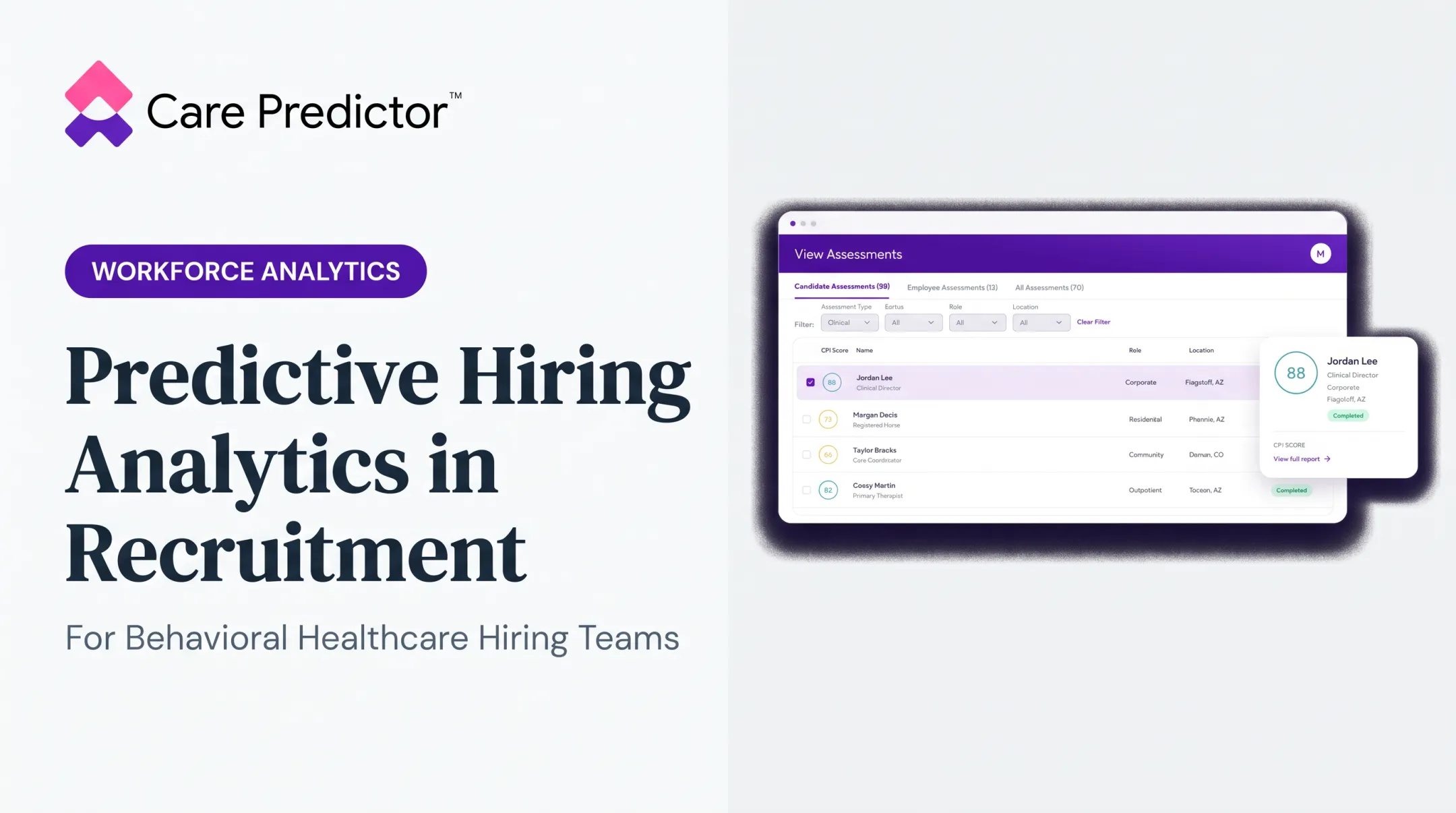
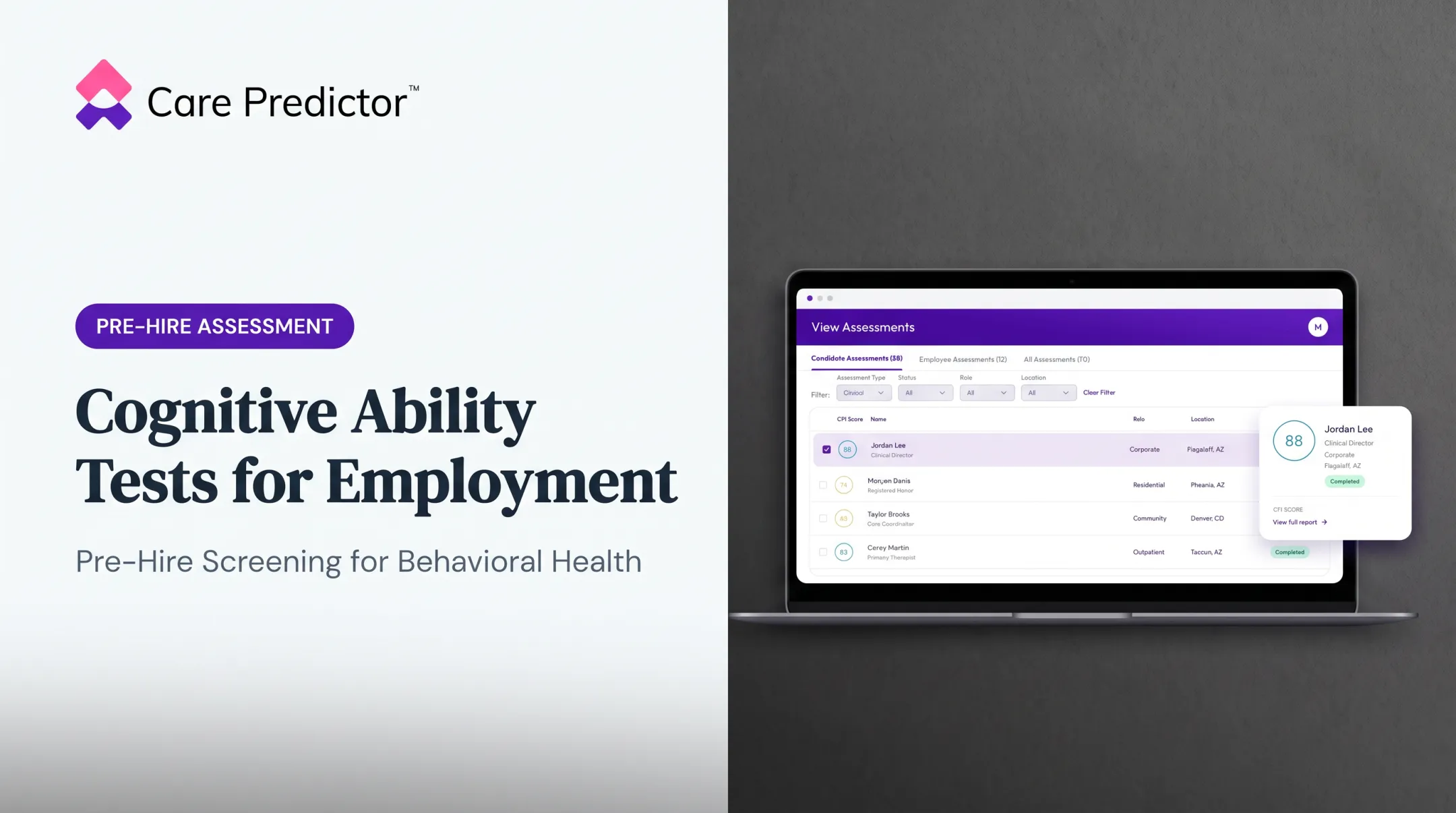
Structured scoring also pairs well with validated behavioral input. Care Predictor's Care Profile Assessment adds a research-backed behavioral layer on top of resumes and interviews, scoring candidates on attributes tied to role and team fit.
PREDICT and INTERVIEW tools feed that evidence into the same documented process above. They inform assessment across the hiring lifecycle with behavioral science and data analytics, while hiring teams keep final judgment.
Key Factors, Common Issues and Misconceptions
A few factors separate scorecards that hold up from ones that fall apart:
- Role relevance: Tie criteria to real job duties and the care setting, not generic "culture fit" or resume prestige.
- Evidence quality: Favor observable, job-related proof; separate verified credentials from self-reported claims.
- Weighting and thresholds: Use role-specific weights. Keep safety-critical credentials as hard gates a high total score cannot override.
- Interviewer calibration: Train on the rubric, share scored examples, and flag evaluators who run consistently high or low.
- Data, privacy, and fairness: Collect only what you need, protect candidate data, and check outcomes across relevant groups.
Even a well-built scorecard fails if teams trust the number more than the evidence behind it. These misconceptions show up often in behavioral health hiring.
Common Misconceptions
A higher score is not proof of future success. It is an estimate from selected evidence and assumptions—useful, not a guarantee.
Scoring does not remove bias by itself. Weak criteria, biased historical data, or inconsistent interviewer behavior can lock bias into the process.
A 2022 meta-analysis of personnel-selection methods found structured interviews ranked as the strongest selection procedure. Structure still cannot make a scorecard fair when the underlying criteria are flawed.
Automation should not make the final call. In 2022, the DOJ and EEOC jointly warned that algorithmic hiring tools can screen out people with disabilities who could do the job with reasonable accommodation. Technology can organize evidence and surface patterns. Qualified people still own the decision.

Resume keywords, personality impressions, and "culture fit" are not full measures of readiness for compassionate behavioral health work. None of them show how someone responds to a client in crisis.
When Candidate Scoring May Not Be Appropriate
A full weighted scoring model isn't always the right tool. Consider something simpler when:
- You're hiring for one role with a single, clearly qualified applicant.
- The job has one non-negotiable legal credential and little else to differentiate candidates.
- You're in an early exploratory conversation with too little evidence to score yet.
In these cases, a checklist or structured interview guide is more transparent and proportionate than a complex model.
Watch for these warning signs that scoring is being used by default rather than by need:
- Scores change without an explained reason.
- Criteria don't connect to actual job duties.
- Candidates get auto-rejected with no human review.
- Testing burden grows well beyond what the role requires.
- Results consistently conflict with what qualified people on the team observe.
If your organization can't explain what a score means, can't protect the underlying data, or can't show that criteria connect to real job outcomes, that's a sign to pause and redesign, not push forward.

Conclusion
Candidate scoring works when it connects four things: clear role requirements, relevant evidence, calibrated evaluation, and documented review. Skip any one of those, and the number stops meaning anything.
For behavioral health organizations, this isn't an academic exercise. Selecting people who can sustain stable teams and deliver compassionate, effective care takes more than resume matching or gut instinct. Patient retention, treatment completion, and staff burnout are too important to leave to chance.
Put the framework into practice:
- Start with job-related criteria
- Keep human judgment at the center of the decision
- Track what happens after you hire, and refine the framework as evidence builds
The payoff is clearer evidence in the hands of people making better hiring decisions.
Frequently Asked Questions
How does interview scoring work?
Interview scoring rates candidate responses against predefined competencies using behaviorally anchored criteria. Interviewers document evidence during or right after each interview, then review it before the hiring team's debrief.
What is the 30-60-90 rule in an interview?
It's a framework for discussing what a candidate expects to accomplish in their first 30, 60, and 90 days on the job. Use it as an interview prompt or onboarding planning tool—not as a universal scoring requirement.
What is the 80/20 rule in interviewing?
It's a common suggestion that the candidate does roughly 80% of the talking while the interviewer uses the remaining 20% to ask and follow up. The exact ratio shouldn't override necessary follow-up questions or accessibility accommodations.
What should be included in a candidate scorecard?
A solid scorecard covers role-relevant competencies, clearly defined rating anchors, and supporting evidence or notes. It should also capture required qualifications, the interviewer's identity, and a final recommendation with rationale.
How can candidate scoring reduce bias in recruitment?
Consistent criteria, structured questions, independent scoring, and calibration reduce subjective variation between interviewers. The scoring framework itself still needs periodic review for biased inputs or proxy variables.
Can candidate scoring replace human judgment?
No. Scoring should support human review, not substitute for it — particularly for behavioral health considerations like empathy, teamwork, and context-specific evidence that a number alone can't fully capture.