Pre-employment testing is a structured way to evaluate job-related skills or behaviors before a hiring decision gets made. Done well, it adds evidence to the process. It should never replace interviews, clinical judgment, or a conversation with the person sitting across from you.
Like most hiring tools, testing cuts both ways. It can make decisions more consistent and evidence-based. It can also introduce bias, create legal exposure, frustrate good candidates, and cause you to overlook real talent if it's designed or applied poorly. This article walks through both sides, plus how to use testing responsibly.
Key Takeaways
- Testing works best when it measures skills directly tied to the role and comes with real validation evidence.
- Assessments add consistency and surface strengths that resumes often hide.
- A test score is one data point, never an automatic pass or fail.
- Fairness, accessibility, job relevance, and data handling all need review before launch.
- Combine testing with structured interviews, not instead of them.
What Does Pre-Employment Testing Measure?
"Pre-employment testing" covers a wide range of tools, and they're not interchangeable:
- Skills assessments - measure specific job tasks, like documentation or crisis de-escalation steps
- Cognitive or aptitude tests - gauge problem-solving speed and reasoning
- Personality and behavioral assessments - assess traits like reliability, empathy, or stress tolerance
- Situational judgment tests - present realistic scenarios and ask how a candidate would respond
- Work-sample exercises - require candidates to perform an actual task from the job
For behavioral health roles, the relevant capabilities often include communication, empathy, emotional regulation, reliability, sound judgment, learning agility, and teamwork. None of these guarantees good performance on its own. A candidate can score high on empathy and still struggle with documentation deadlines or team conflict.
Start With a Job Analysis
Before picking any tool, map out what the role actually requires. A peer-support specialist and a clinical director need very different capabilities, even though both work in the same facility. Skipping this step is how organizations end up using one generic test across unrelated positions.
The Pros of Pre-Employment Testing
Improve Consistency and Reduce First-Impression Bias
Standardized questions, scoring criteria, and administration conditions make candidate comparisons more consistent than an unstructured resume review or a free-flowing interview. That said, consistency isn't the same as fairness. A standardized test can still be irrelevant to the job or inaccessible to some applicants.
Verify Capabilities Resumes and Interviews Miss
A resume shows where someone worked. A work sample or situational judgment exercise shows how they'd actually handle a challenging client interaction, say, a patient threatening to leave treatment against medical advice. These exercises add evidence, but they shouldn't replace the deeper conversation a full interview provides.
Make High-Volume Hiring More Efficient
Recruiting is expensive and slow. SHRM's recent benchmarking puts the average nonexecutive cost-per-hire at roughly $5,475, with screening and interviewing alone averaging 8 to 9 days according to SHRM's 2025 report. Testing can't guarantee faster hiring, but it does help recruiters prioritize which candidates deserve that time investment first.

Support Better Role Alignment
Clearer, job-relevant evaluation can reduce the gap between what a candidate can actually do and what the role demands. This is a hypothesis worth testing, not a guarantee. Compare assessment results against later measures like training completion, performance, and retention to see whether the connection holds in your own organization.
Create Useful Data for Interviews and Development
Assessment results can sharpen the interviews that follow. Instead of generic questions, interviewers can probe the specific areas an assessment flagged as uncertain.
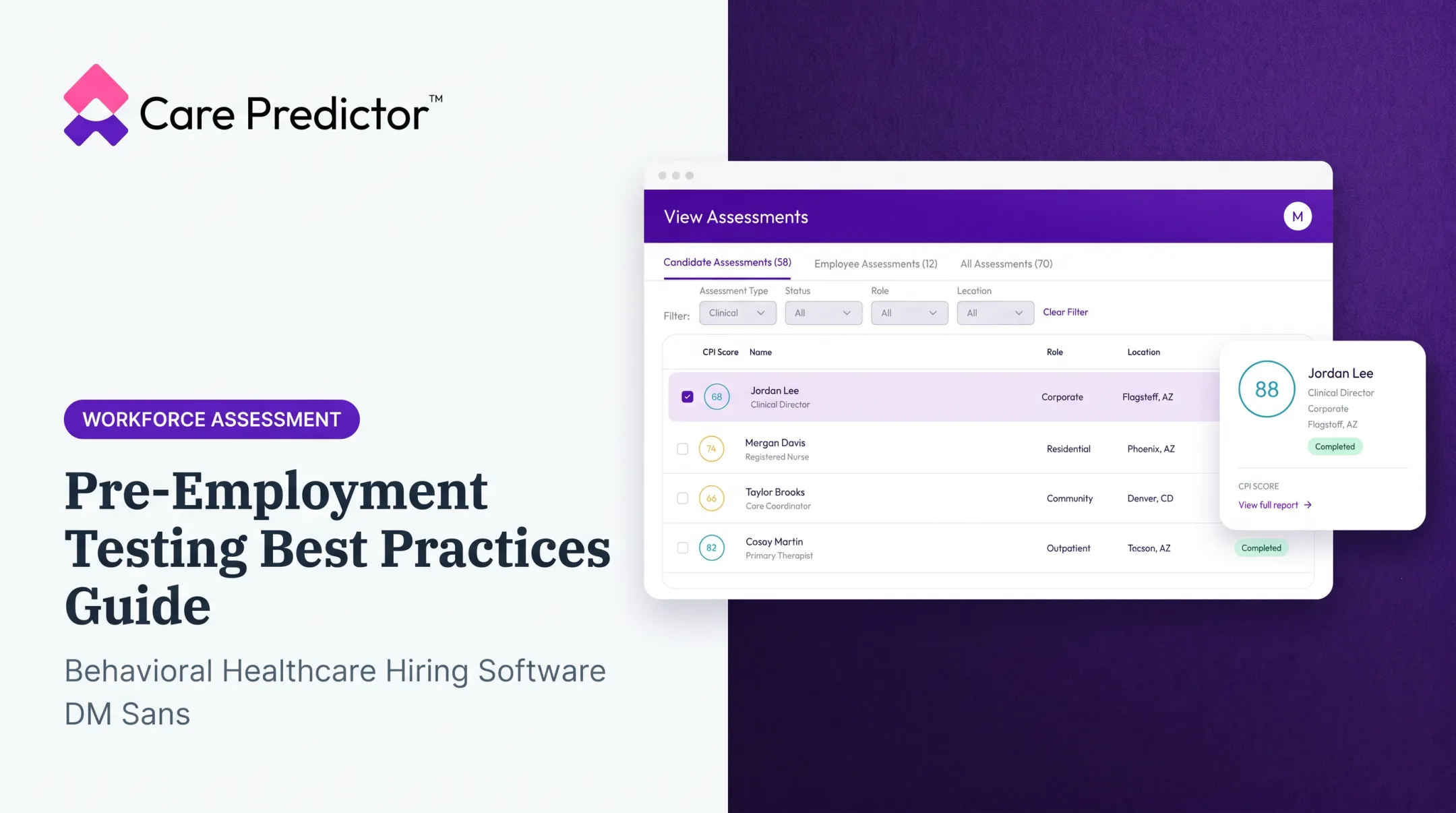
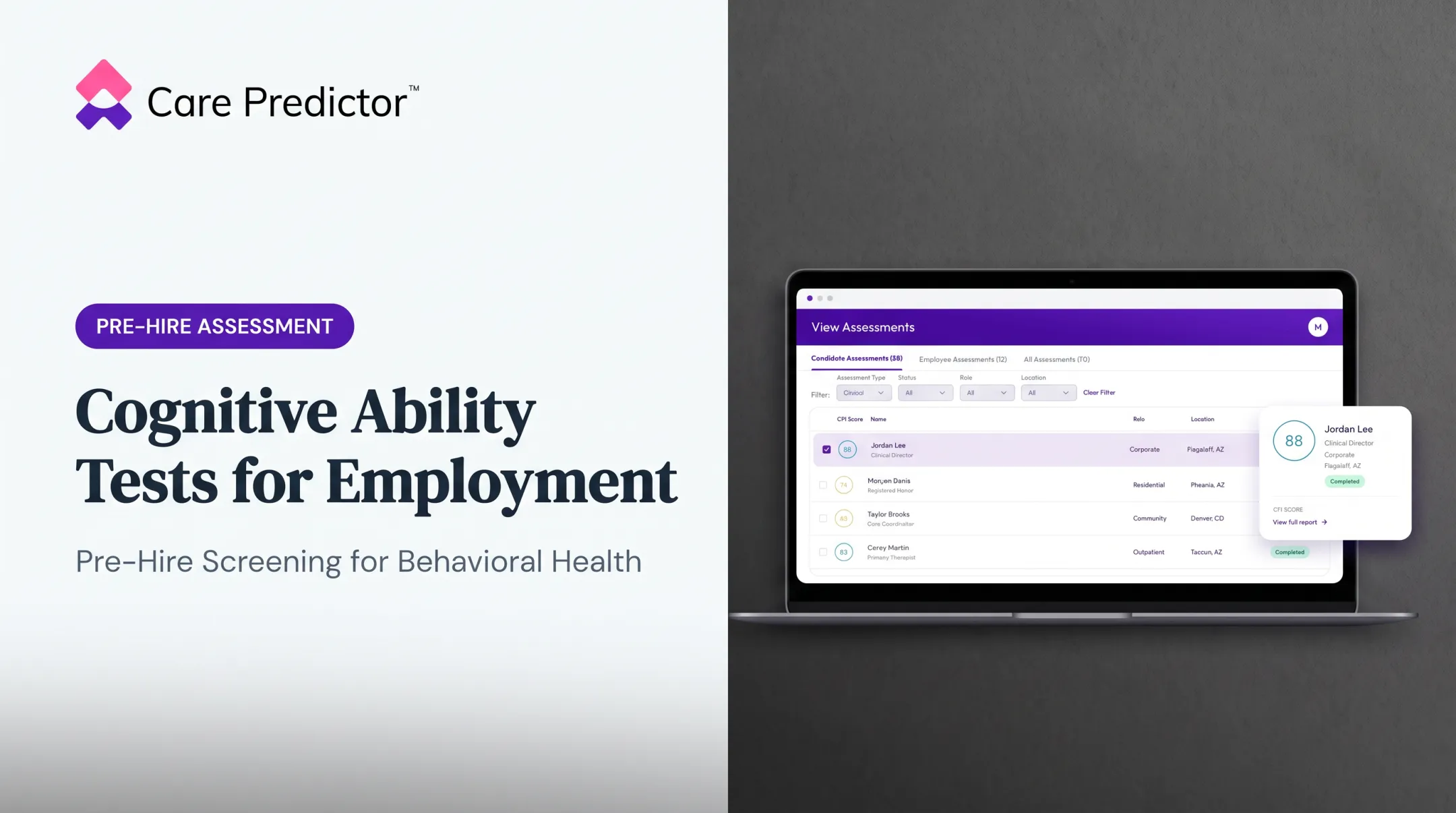
Care Predictor's Pre-Hire Care Profile Assessment, for example, evaluates candidates across 24 research-verified behavioral attributes and generates role-specific interview questions alongside a candidate fit dashboard. The platform is built around combining behavioral science with data analytics, while keeping the interview itself a human conversation rather than a scored checkbox exercise.
The Cons and Risks of Pre-Employment Testing
Assessments May Be Invalid, Unreliable, or Poorly Matched
Validity means a test measures what it claims to measure and predicts a relevant outcome. Reliability means it produces consistent results. A test can be perfectly reliable and still useless if it measures something unrelated to the job. Before adopting any tool, ask the vendor for its validation studies, target population, and job-specific evidence.
Testing Can Introduce or Reinforce Bias
Language, cultural background, disability, technology access, and scoring thresholds can all skew results in ways that have nothing to do with job performance.
EEOC's adverse-impact guidance uses the four-fifths rule as a screening check: if one group's selection rate falls below 80% of the highest-scoring group's rate, that's a signal to investigate, not a conclusion in itself.

Monitoring adverse impact on an ongoing basis matters more than running one check at launch.
Scores Can Create False Confidence or Exclude Strong Candidates
No score is error-free. Test anxiety, unfamiliarity with a testing format, or simply lacking prior exposure to a task can all drag down a capable candidate's result. A low score should prompt a closer look, not an automatic rejection.
A Poor Candidate Experience Can Damage Your Employer Brand
Long, confusing, or invasive assessments push qualified applicants to abandon the process before they ever reach an interview. Fix this by:
- Giving clear instructions and realistic time estimates
- Delivering the assessment in an accessible format
- Explaining how results will actually be used
- Following up promptly, win or lose
Testing Creates Legal, Privacy, and Operational Responsibilities
U.S. employers need to keep assessments job-related, administer them consistently, and offer reasonable accommodations. The ADA restricts medical or disability-related inquiries before a conditional job offer, and personality tests that start probing for mental disorders can cross into that territory.
Document your process, protect candidate data, and talk to employment counsel before scaling any assessment program. None of this article should be taken as legal advice.
How to Use Pre-Employment Testing Responsibly
Start With the Job, Not the Test
Document the essential duties of each role first, whether that's a counselor, nurse, peer-support specialist, or administrative position. Identify which capabilities genuinely drive success. Using one generic personality test across every role in your organization is a shortcut that usually backfires.
Select Scientifically Supported, Transparent Assessments
Before buying any tool, check for:
- Validation evidence tied to your specific jobs
- Reliability data and scoring transparency
- Accessibility and accommodation options
- Data security practices and vendor support
- Documentation you can produce if audited
SIOP's validation standards and EEOC guidance on employee selection procedures both outline the evidence employers should expect. Vendor claims don't remove your own responsibility to confirm job relevance.
Combine Testing With Structured Interviews
Use assessment results alongside structured interviews, work samples, reference checks, and credential verification. A behavioral health employer might pair a scenario-based exercise, like responding to a client in crisis, with consistent follow-up questions about boundaries, teamwork, and stress response.

Monitor Fairness and Predictive Value After Launch
Testing isn't a set-it-and-forget-it decision. Track:
- Completion and selection rates by group, where legally appropriate
- Accommodation requests
- Downstream performance, training outcomes, and retention
- Candidate feedback on the process itself
Review cut scores periodically to confirm the assessment still predicts what you need it to, and isn't quietly screening out qualified applicants.
Connect Pre-Hire Insights to Onboarding
Assessment data shouldn't vanish after the offer letter goes out. Findings can shape individualized onboarding, coaching, and development plans, without permanently labeling an employee based on one test. Care Predictor's broader workforce-intelligence approach follows this model. Care Profile reports flag a candidate's natural strengths and growth areas, then hand leaders a starting plan for coaching and ramp-up. The technology supports the relationship between manager and new hire rather than standing in for it.
Conclusion
Pre-employment testing helps only when the tools meet standards for scientific quality, job relevance, fairness, and candidate experience, and when results are interpreted responsibly.
For behavioral health leaders, the practical move is clear: use assessments to add evidence to hiring decisions, then pair that evidence with structured human evaluation and ongoing workforce measurement. Neither piece works as well alone.
Frequently Asked Questions
How should you prepare for pre-employment tests?
Review the job requirements beforehand, follow instructions carefully, and set up a quiet, reliable testing environment. Request any needed accommodations in advance, and answer honestly instead of guessing at the "ideal" personality.
Can you fail a pre-employment assessment and still get hired?
Yes, in many organizations. Most employers treat assessments as one input rather than a standalone pass/fail gate, so interviews, work samples, experience, and references can still carry the decision.
What are the pros and cons of pre-employment testing?
Pros include more consistent comparisons, verified skills, and faster screening in high-volume hiring. Cons include bias risk, poor validity if misapplied, candidate frustration, legal exposure, and over-reliance on a single score.
Are pre-employment tests legal in the United States?
Generally, yes, when the test is job-related, consistently administered, properly validated, and accessible to applicants with disabilities. State and federal requirements vary, so employers should get guidance from qualified employment counsel.
What types of pre-employment tests are used?
Common categories include skills tests, cognitive assessments, situational judgment tests, work samples, and behavioral or personality assessments. The right type depends entirely on what the specific role actually requires.