Behavioral health organizations hire into roles where that gap matters more than most industries do. Sixty-two percent of surveyed mental health and substance use disorder workers reported moderate or severe burnout in 2023, and nearly half said workforce shortages had them considering leaving the field. Structured psychometric tools won't fix every staffing challenge, but they can add consistent, job-relevant evidence that resumes and unstructured interviews consistently miss.
This article covers the main assessment types, what separates a scientifically sound tool from a dressed-up personality quiz, how behavioral health organizations apply these tools across hiring and retention, and how to evaluate a platform without treating any single score as a hiring verdict.
Key Takeaways
- Psychometric tools add structured evidence on abilities, behavior, and motivation that interviews alone often miss
- Tool choice should follow the job decision, not a vendor's brand name or feature list
- Reliability, validity, fairness, and privacy practices determine whether a tool actually holds up
- Real impact comes from pairing assessment data with onboarding, development, and retention follow-through
What Are Psychometric Tests and Tools?
Standardized vs. Informal Assessment
A psychometric test is a standardized way to measure a psychological characteristic: cognitive ability, personality traits, behavioral tendencies, motivation, interests, values, or emotional capabilities. The word "tool" gets used loosely in this space. It might mean a single assessment, the scoring system behind that assessment, or an entire software platform bundling several assessments with reporting and workflow features.
What separates a real psychometric instrument from an informal personality quiz is evidence. SIOP's Principles for the Validation and Use of Personnel Selection Procedures, adopted as APA policy, defines validity as how well evidence and theory support score interpretations for a proposed use.
In plain terms, a tool isn't "validated" just because it's internally consistent or produces a polished-looking report. It has to show that scores mean what the vendor claims for the specific job and decision you're using it for.
Standardization also matters in day-to-day administration. Every candidate should take the same version, under comparable conditions, scored the same way. An interviewer's gut read on "culture fit" doesn't meet that bar, regardless of how experienced the interviewer is.
Care Predictor's Care Predictor Index is one example of a purpose-built instrument: a 234-item assessment that draws on three established measures (the Adult Attachment Questionnaire, Counselor Activity Self-Efficacy Scales, and the Analog to Multi-Broadband Inventories). It scores 24 provider characteristics tied to therapeutic alliance and patient outcomes.
A shorter 192-item version exists for non-counseling roles.
Where Assessments Fit in the Employee Lifecycle
Psychometric tools aren't just a pre-hire filter. Organizations apply them across several points:
- Pre-hire screening - adding structured evidence alongside resumes and work samples
- Structured interviews - generating role-specific questions based on assessment results
- Onboarding - flagging coaching needs and communication preferences early
- Leadership development - identifying readiness and growth areas for supervisors
- Retention planning - combining assessment data with engagement signals to spot strain
Used this way, assessments become a thread running through the employment relationship, not a one-time hurdle at the hiring stage.
Common Types of Psychometric Tests and Tools
Here's a quick breakdown of the main categories and where they apply:
| Assessment Type | What It Measures | Behavioral Health Caution |
|---|---|---|
| Cognitive/aptitude | Verbal, numerical, logical reasoning, problem-solving, learning agility | Most relevant for admin, clinical-support, or supervisory roles; higher adverse-impact risk if misapplied |
| Personality/behavioral | Communication style, response to pressure, collaboration preferences | A profile is not proof of compassion or clinical skill |
| Motivation, values, EI | Work drivers, interpersonal awareness, resilience-related behaviors | Context for fit, not a diagnosis |
| Situational judgment (SJT) | Responses to realistic workplace scenarios | Scenarios should reflect actual clinical or operational situations |
| Multi-assessment platforms | Several assessment types bundled with reporting and analytics | A polished interface doesn't equal test validity |
Cognitive, Personality, and Motivation Measures
Cognitive and aptitude tests can matter for roles where reasoning speed or problem-solving load genuinely factors into the job—think utilization review or clinical documentation. They're less relevant to measuring whether someone can sit with a patient in crisis.
Personality and behavioral inventories show communication patterns and collaboration style. Care Predictor's AMBI component, for instance, is a public-domain 181-item inventory capturing traits measured across eight established personality frameworks. These measures describe tendencies. They shouldn't sort candidates into "good" or "bad" buckets, and a dominant trait profile isn't evidence of clinical competence on its own.
Motivation, values, and emotional intelligence assessments add context: why does someone want this work, and how aware are they of their own and others' emotional states? These assessments inform conversations about resilience and fit. They don't diagnose burnout risk by themselves.
Simulations and Multi-Assessment Platforms
Situational judgment tests and job simulations ask candidates to respond to realistic scenarios: a distressed patient escalating in the lobby, a scheduling conflict between two team members, or competing priorities during a short-staffed shift. These complement personality data by showing how someone applies judgment under pressure rather than how they describe themselves.

Multi-assessment platforms combine several of these categories into one workflow, often with dashboards, integrations, and analytics layered on top. That convenience is real. Ease of use and scientific defensibility are separate questions: Is the platform easy to use? And is the science behind each test defensible? A clean interface says nothing about whether a personality scale was validated for your population.
How Behavioral Health Organizations Can Use Psychometric Tools
The Bureau of Labor Statistics projects 18% employment growth and roughly 50,500 annual openings for substance abuse, behavioral disorder, and mental health counselors through 2035.
Speed of hiring matters. So does hiring well enough that people stay once they're in the door.
Pre-Hire Selection and Onboarding
For clinical, care, operations, and leadership roles, assessments add structured evidence to interviews and work samples—they shouldn't replace either. A residential counselor candidate still needs credentials verified and judgment tested in real scenarios. An assessment adds a consistent layer under those checks.
Once someone's hired, the same data can inform onboarding:
- Coaching priorities based on identified gaps
- Communication preferences for new supervisors
- Learning supports tailored to how someone processes information
- Leadership-development focus areas for high-potential staff
Treat results as a starting point for development conversations, not a permanent label in someone's personnel file.
Team Dynamics and Retention Signals
Behavioral health work depends on multidisciplinary collaboration, shift handoffs, supervisory relationships, and the therapeutic alliance between provider and patient. Assessment data, aggregated across a team, can highlight communication gaps or conflict patterns worth addressing. It should not mean exposing one person's full profile to the whole unit.
No psychometric test predicts burnout or turnover on its own. Stronger signals come from pairing assessment and engagement data with turnover-intent surveys, stay interviews, workload metrics, and manager feedback. In substance use treatment settings, staff turnover has been reported as high as 50%—pressure that makes early signal-spotting valuable, and that no single tool solves alone.

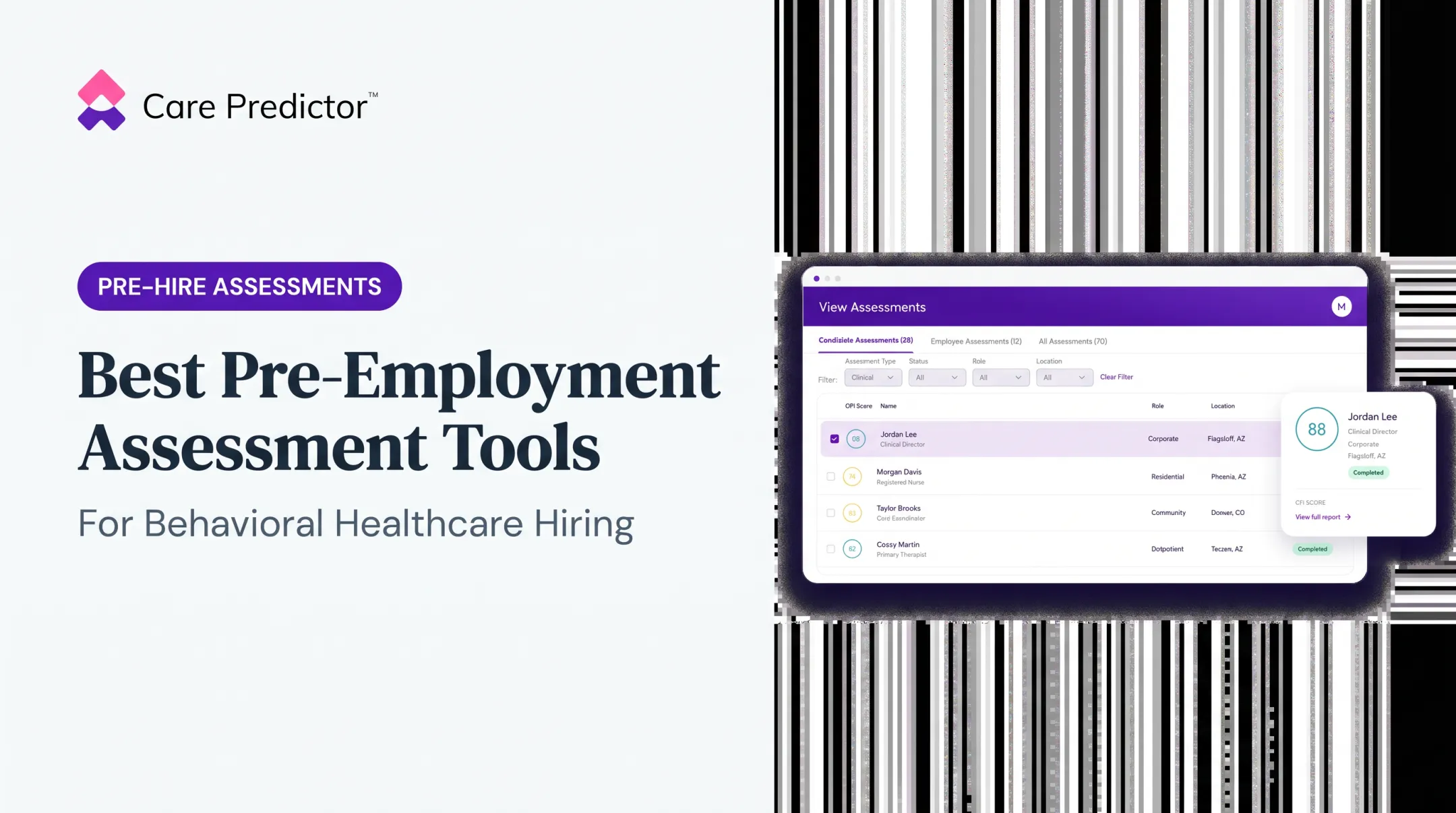
Care Predictor's approach reflects this combined view. The platform pairs behavioral science and workforce analytics across hiring, onboarding, engagement, and retention—including the Care Predictor Index, employee surveys, and attrition-risk flags.
The aim is earlier, more consistent information for managers so they can act before strain becomes an open role. Coaching and support still happen between people.
What Makes a Psychometric Tool Trustworthy?
Trustworthy psychometric tools rest on reliable measurement, valid job-related predictions, and fair, defensible use. Without clear evidence on each, hiring scores are hard to trust.
Reliability and Validity
Reliability means a tool produces consistent results across repeated administrations, items within the test, and raters when scoring involves judgment. Ask any vendor which type of reliability evidence they report, and for which population. A tool that's reliable with sales candidates isn't automatically reliable with addiction counselors.
Validity goes further: does the score actually predict or relate to the job-relevant outcome it claims to measure? SIOP's Principles for the Validation and Use of Personnel Selection Procedures is explicit that validity depends on the proposed use of test scores, and it rejects marketing claims or testimonials as a substitute for evidence. Four types matter most:
- Content validity - does the test content reflect actual job tasks?
- Construct validity - does it measure the trait it claims to measure?
- Criterion-related validity - does the score correlate with a real outcome, like performance or retention?
- Job-related validity - has it been validated for this specific role, population, and language?
Outcome-linked data can be a useful signal here. Care Predictor, for example, tracked 7,325 treatment episodes over two years and found that therapists scoring 80 or above on their Care Profile completed 25% more treatments and lost 29% fewer patients to against-medical-advice discharge.

That's the kind of evidence worth requesting from any vendor, not a universal benchmark every tool is expected to match.
Fairness, Accessibility, and Legal Defensibility
Even a reliable, valid tool can create risk if it is used unfairly or without accommodations. Standardization and norms matter because a score is only meaningful when compared against a relevant reference group. Beyond the underlying science, U.S. employers need to watch:
- Adverse impact - the EEOC's four-fifths rule flags a potential issue when one group's selection rate falls below 80% of the highest group's rate
- Accessibility - computer-based assessments must accommodate candidates with disabilities
- Data privacy - vendors should document data minimization, storage limits, and certifications such as SOC 2 or ISO 27001
- Vendor transparency - technical documentation should be available on request, not withheld as proprietary
Ask vendors directly how they monitor selection-rate differences across groups and how accommodation requests are handled. If they can't answer clearly, that tells you something too.
How to Choose and Implement a Psychometric Tool
Match the Tool to the Decision
Start with what you're actually trying to learn: cognitive ability, behavioral tendencies, role-specific competencies, development needs, or team dynamics. Map that decision to observable job requirements before you look at a single vendor demo.
When comparing providers, weigh:
- Scientific documentation and validation evidence
- Relevance to the specific role and population
- Candidate experience and completion rates
- Accessibility and accommodation support
- Reporting clarity for non-specialist hiring managers
- Integration with your ATS or HRIS
- Security certifications and data handling practices
Brand recognition and feature count should not outweigh validation evidence for your actual roles. In behavioral health hiring, favor platforms that document role-relevant science and strong data protections (for example ISO 27001 and SOC 2).
Build a Consistent Process, Then Pilot It
Define the workflow before rollout: when the assessment happens in the hiring sequence, who reviews results, how scores feed structured interview questions, and which findings require human judgment rather than automated scoring. A typical behavioral health hiring flow might look like this:
- Candidate completes the assessment after initial screening
- Hiring manager receives a report alongside role-specific interview questions
- Interview panel discusses results as one input, not a pass/fail gate
- Selected hires get a development plan built around identified coaching needs
Tell candidates upfront why they're being assessed, how long it takes, and how results will be used. Train hiring teams to read reports as context, not verdicts, since confirmation bias creeps in fast when a manager already has a favorite candidate.
Pilot before expanding. Track measures that show whether the tool is working in practice:
- Quality of hire
- Retention
- Assessment completion rates
- Fairness across groups
- Manager adoption
Ocean View Psychiatric Hospital, a 39-bed facility licensed by the California Department of Health and Human Services, used this kind of structured approach and reported a 9% improvement in treatment completion and a 43% reduction in AMA discharges. Gains like those follow consistent process design, manager training, and follow-up—not the assessment score in isolation.
Frequently Asked Questions
What are some popular psychometric testing platforms?
Popular platforms vary by assessment type, industry, geography, and validation evidence. Compare scientific documentation and behavioral-health relevance rather than a general popularity ranking.
What is the best personality assessment tool?
There's no universally best personality assessment. The right choice depends on your job question, validated use case, population, reporting quality, and how results combine with other hiring evidence.
What are the top psychometric tests?
Common types include cognitive ability, aptitude, personality, behavioral, emotional intelligence, motivation, values, and situational judgment tests. Which ranks highest depends on the decision and role you're assessing for.
What are psychometric test tools?
Psychometric test tools are standardized assessments or platforms that measure ability, personality, motivation, and other job-related traits. Unlike informal quizzes, they use consistent administration, scoring, and documented evidence of what they measure.