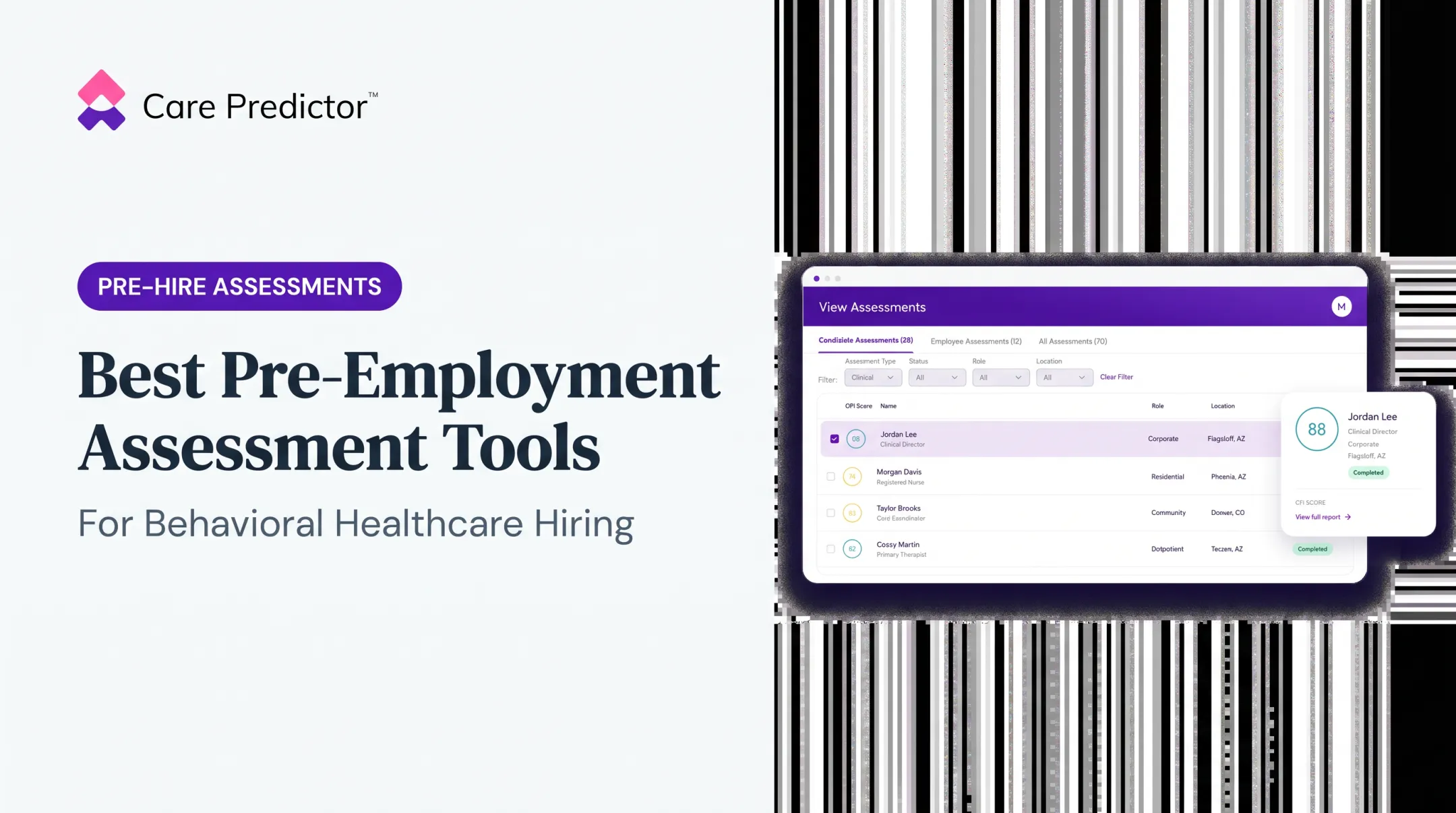
The numbers back up the concern. Behavioral health RNs saw 22.8% turnover in 2025, compared to 17.6% across all RN specialties, according to the 2026 NSI National Health Care Retention & RN Staffing Report. This article explains what pre-hire questionnaires and assessments actually measure, how they differ, and how to use them as one part of a fair, structured hiring process, not a replacement for interviews, professional judgment, or candidate connection.
Key Takeaways
- Questionnaires gather candidate information; assessments evaluate job-related skills, behaviors, or traits using a defined scoring method.
- The strongest hiring process ties assessment content directly to role requirements and scores every candidate the same way.
- Focus on care-relevant competencies: communication, judgment, resilience, teamwork, and reliability, not vague "culture fit."
- Review validation, accessibility, privacy, and employment-law requirements before rolling out any tool.
What Are Pre-Hire Questionnaires and Assessments?
A pre-hire questionnaire is a set of questions candidates complete before an interview or hiring decision. It typically collects self-reported information about qualifications, availability, experience, communication style, or work preferences. Think of it as structured intake, not a scored test.
A pre-employment assessment is different. It uses standardized items, scoring rubrics, or simulations to evaluate job-related competencies. According to SHRM's research on selection assessment methods, tools like situational judgment tests and structured interviews each serve a distinct, documented purpose rather than functioning as interchangeable formats.
Where Each Tool Fits in the Hiring Funnel
That distinction only helps if you sequence the tools well. Front-loading lengthy, duplicative testing before candidates understand the role is a fast way to lose strong applicants.
- Eligibility and availability — confirm licensure, schedule fit, and work authorization first.
- Role-relevant assessments — evaluate job-related competencies after basic screening.
- Structured interviews — use assessment results to focus interviewer evaluation last.

Common Assessment Categories
- Cognitive or learning measures — problem-solving, reasoning, and ability to learn clinical or operational procedures
- Skills or job simulations — applying role-specific knowledge to realistic care or support tasks
- Behavioral or motivation measures — interpersonal tendencies, persistence, and work preferences under stress
- Situational judgment tests — how a candidate handles patient, coworker, or confidentiality scenarios
No assessment alone proves future performance, clinical competence, licensure status, or retention. It narrows uncertainty in behavioral health hiring; it does not eliminate it.
| Tool | Primary purpose | Compliance note |
|---|---|---|
| Questionnaire | Collect self-reported background | Questions must stay job-related |
| Assessment | Score job-related competencies | Requires validation evidence |
| Structured interview | Standardize interviewer evaluation | Needs consistent rubric |
| Reference check | Verify prior work conduct | Subject to consent rules |
| Background check | Verify records and criminal history | Governed by FCRA and state law |
Why Use Them in Behavioral Health Hiring?
Behavioral health hiring happens under pressure. Mental health workers and psychiatric aides faced 30.93% turnover in 2025, per the Hospital & Healthcare Compensation Service's 2025 Behavioral Health survey, covering 474 facilities and nearly 39,000 employees. Standardized tools add structure when every open requisition feels urgent.

Better Screening, Less Guesswork
- Surfaces minimum qualifications before a manager invests an hour in an interview
- Confirms schedule fit and relevant experience early in the process
- Cuts overreliance on resume formatting or a polished first-call impression
- Gives every candidate the same job-related screen instead of ad-hoc judgment calls
Quality of Hire and Team Stability
The real goal is matching candidates to the job as it is lived day to day: unpredictable schedules, emotionally demanding interactions, and documentation that does not pause for a bad day.
Care Predictor’s Pre-Hire Care Profile Assessment evaluates candidates across 24 research-verified behavioral attributes tied to therapeutic alliance and outcomes. In an internal review of two years and 7,325 treatment episodes, therapists scoring 80 or above on their Care Profile:
- Completed 25% more treatments
- Lost 29% fewer patients to AMA discharge
Sharper Interviews, Better Candidate Experience
Assessment results can point interviewers toward focused follow-up questions about boundaries, conflict management, or learning needs, rather than generic small talk. Candidates benefit too. Telling applicants why an assessment exists, how long it takes, and what happens next feels more transparent than opaque resume screening.
A caution worth repeating: poorly designed questionnaires can introduce bias, screen out capable people, or reward self-presentation over actual job fit. No single score should function as an automatic reject or hire rule without professional review.
What Should a Behavioral Health Pre-Hire Assessment Include?
Start with a job analysis, not a question bank. Identify essential duties, patient population, schedule demands, and the behaviors that separate your strongest performers from everyone else.
Pull input from hiring managers, experienced clinicians, and compliance leaders before writing a single item.
Core Competency Areas
- Compassionate communication: listening, explaining clearly, and maintaining boundaries
- Emotional regulation and resilience under stress and difficult interactions
- Judgment and safety awareness, including escalation, protocols, and confidentiality
- Reliability and accountability in attendance, follow-through, and ownership of mistakes
- Teamwork and conflict management across disciplines and feedback conversations
- Learning agility with new policies, evidence-based practices, and supervision
Care Predictor’s Care Predictor Index applies this approach at scale with a 234-item instrument (192 items for non-counseling roles). It draws on established psychometric measures to assess characteristics empirically linked to patient outcomes.
Matching Format to Purpose
- Eligibility questions for licensure, certifications, and work authorization
- Situational judgment prompts for realistic workplace scenarios
- Validated behavioral measures only when traits are demonstrably job-relevant
- Work samples for documentation, handoffs, or de-escalation planning, with privacy safeguards
A strong prompt asks how a candidate would respond when a client becomes distressed mid-session, or for an example of changing a practice after corrective feedback. Score these against observable behaviors, not whether the answer matches a manager’s personal style.
Avoid:
- Questions about protected characteristics, family plans, religion, or disability status
- Vague “culture fit” prompts that reward similarity to current staff
- Items that require disclosure of confidential patient information
| Competency | Job duty | Observable indicator | Follow-up interview question |
|---|---|---|---|
| Emotional regulation | De-escalating agitated clients | Stays calm, follows protocol | "Walk me through your last de-escalation." |
| Reliability | Shift coverage | Attendance record, punctuality | "Tell me about a time you had to adjust your schedule last-minute." |
| Communication | Clinical documentation | Clear, accurate notes | "How do you handle documentation after a difficult session?" |
How to Implement Pre-Hire Questionnaires Fairly and Effectively
A good tool used poorly still creates risk. Follow a deliberate sequence:
- Define the role through job analysis so every item maps to real duties.
- Choose or validate the assessment tool against that role profile.
- Pilot it with hiring managers and clinical staff before full rollout.
- Establish consistent scoring rules and apply them the same way every time.
- Train reviewers on interpretation so scores inform—not replace—judgment.
- Document the process for every hire to support audit and fairness reviews.

Fairness and Accessibility
The EEOC's guidance on employment tests and selection procedures is clear. Treat these as non-negotiables:
- Keep every tool job-related and consistently administered
- Monitor results for disparate impact across groups
- Offer reasonable accommodations and an alternate process when a disability affects the standard format
Candidate Communication and Data Handling
Tell candidates the time commitment, the purpose, and what happens after they submit. Address consent, data retention, and vendor security directly—and ask vendors to show how they meet those bars. Care Predictor, for example, maintains ISO 27001:2022, SOC 2, and PCI-DSS 4.0 certifications and aligns with the NIST Cybersecurity Framework. Certifications help, but they do not cover every state or federal privacy duty your organization still owns.
Strong data handling should not slow hiring. Care Predictor's rollout typically runs signup and kickoff on day one, platform setup on day two, and live pre-hire assessments by day three, with no EMR integration required to start.
Measuring Whether It Works
Track these over time, not just at launch:
- Completion rates and candidate withdrawals
- Time to screen and interview progression
- Quality-of-hire and retention indicators
- Adverse-impact signals across demographic groups
One psychiatric hospital using Care Predictor's framework found providers scoring 70 or higher on the CPI delivered a 6.8% higher treatment-completion rate and a 4.3% lower AMA rate, translating to roughly $211,710 in modeled incremental revenue.
Revisit your assessment whenever job duties, regulations, or care models shift.
Conclusion
Pre-hire questionnaires and assessments make behavioral health hiring more structured and evidence-informed, but only when they measure what the role actually requires. The strongest process pairs validated assessment data with structured interviews, references, accommodations, and genuine conversation with the candidate.
Care Predictor built its Pre-Hire Care Profile Assessment around this principle: 24 research-verified attributes, role-specific interview guides, and reports designed to inform human judgment rather than replace it. If you're rethinking how your organization screens, interviews, and predicts candidate success, talk to Care Predictor about applying that research to your own hiring.
Frequently Asked Questions
What is a pre-hire questionnaire?
A pre-hire questionnaire is a set of questions candidates complete before an interview or hiring decision. It collects qualifications, availability, experience, or work-related behaviors and usually isn't scored against a standardized rubric the way a formal assessment is.
What are some common questions asked during a prescreening interview?
Expect questions about relevant experience, required credentials, availability, and motivation for the role. Many pre-screening interviews also ask how you've handled specific workplace situations, such as a difficult client interaction.
Does pre-hire mean you got hired?
No. "Pre-hire" refers to the stage before employment begins. Completing a questionnaire or assessment is part of the evaluation process, not confirmation of a job offer.
What should a pre-employment assessment measure?
It should measure job-related competencies—skills, judgment, communication, or behavioral tendencies tied to success in that role. Avoid generic traits that aren't linked to the job.
Are pre-hire assessments legal in the US?
Yes, when they're job-related, consistently administered, accessible, and designed to avoid discriminatory impact. Employers should consult current legal guidance, since requirements vary by state and change over time.