The challenge isn't access to data. Most healthcare organizations are drowning in it, scattered across electronic health records, claims systems, spreadsheets, and surveys that rarely talk to each other. Turning that fragmented mess into predictions clinicians and operators can actually trust requires solid data foundations, careful validation, and human judgment at every step.
This guide covers what predictive analytics means in healthcare, the data behind it, the models powering the scores, where it delivers measurable value, the risks involved, and how behavioral-health organizations specifically apply it to workforce decisions, not just patient care.
Key Takeaways
- Predictive analytics estimates likely outcomes using historical data, statistics, and machine learning without guaranteeing them.
- Predictions are only as reliable as the data quality, representativeness, and governance behind them.
- Highest-value uses include clinical risk flags, care planning, staffing, patient flow, and fraud detection.
- Models should inform clinical judgment and operational decisions, never replace them.
- Behavioral-health organizations increasingly apply the same discipline to workforce decisions as they do to patient care.
What Is Predictive Analytics in Healthcare and How Does It Work?
Healthcare analytics generally falls into three categories, and mixing them up causes a lot of confusion in strategy meetings.
| Analytics Type | What It Answers | Example |
|---|---|---|
| Descriptive | What already happened | Last quarter's readmission rate |
| Predictive | What's likely to happen | This patient's 30-day readmission risk |
| Prescriptive | What to do about it | Recommended discharge-planning steps |
Predictive analytics sits in the middle. It takes historical and current data and estimates a future event (a readmission, a no-show, a staffing gap) using statistical models or machine learning.
The standard workflow looks like this:
- Define the target outcome: what are you actually trying to predict?
- Select relevant variables: which data points plausibly relate to that outcome?
- Prepare the data: clean, standardize, and structure it for modeling.
- Train the model: let the algorithm learn patterns from historical cases.
- Validate: test performance on data the model hasn't seen.
- Deploy and monitor: put it into workflows and watch how it performs over time.
- Recalibrate: retrain periodically as populations and practices shift.
A prediction expresses likelihood, not certainty. A risk score of 70% doesn't mean an event will happen. It means that, among similar patients historically, roughly 7 in 10 experienced that outcome. Context matters: clinical judgment, operational constraints, and patient preference all shape what happens next.

Common Predictive Analytics Models
Five model families show up repeatedly in healthcare applications, and none of them wins universally.
| Model | Healthcare Example |
|---|---|
| Regression | Estimating probability of hospital readmission |
| Classification | Flagging patients likely to miss an appointment |
| Decision trees / random forests | Predicting stroke recovery at 90 days |
| Clustering | Grouping patients into clinical phenotypes |
| Time-series forecasting | Projecting hourly hospital census |
Model choice depends on the question, the data available, and whether interpretability matters. A simpler regression model that clinicians can explain may beat a marginally more accurate "black box" if trust and adoption matter more than a few decimal points of accuracy.
In practice, the strongest model often changes by outcome and dataset. That is why no single approach is universally superior.
From Prediction to Action
A risk score is only useful once it's tied to a specific intervention, an owner, and a follow-up measurement. Otherwise, it's just a number sitting in a dashboard nobody checks.
Take a readmission-risk flag. On its own, it does nothing. Connected to a workflow, it prompts a case manager to review discharge planning for that patient. The goal is not to extend a stay or override clinical judgment automatically, but to support a more informed conversation.
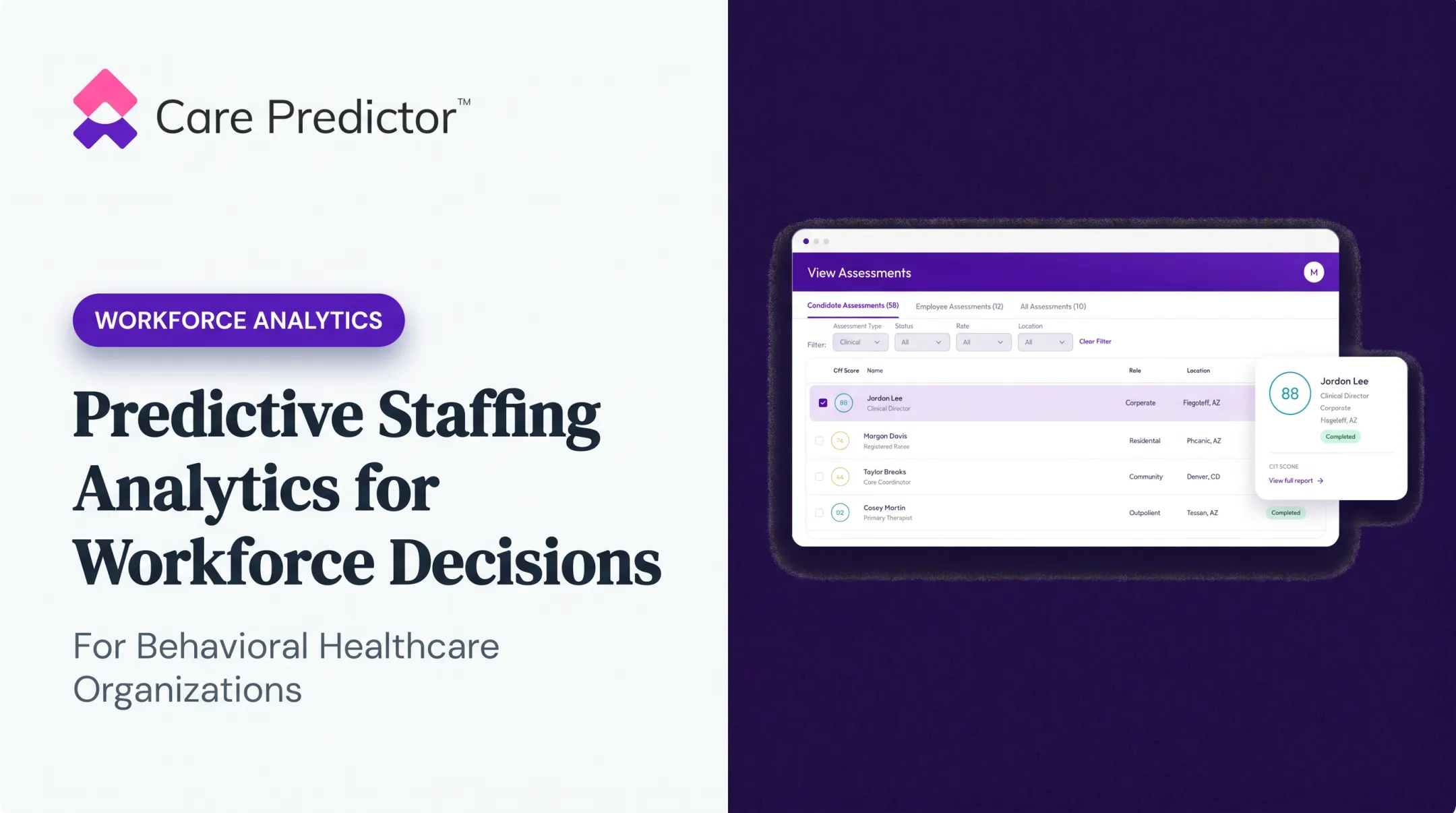
Care Predictor applies this same logic to behavioral health workforce decisions. Its platform combines behavioral science with data analytics to support pre-hire assessment, engagement feedback, and retention-focused predictions. Those signals inform leaders; they do not make the hiring or care decision themselves.
What Data Powers Predictive Analytics in Healthcare?
Predictions are only as good as the data feeding them. Common sources include:
- Electronic health records (diagnoses, vitals, orders)
- Claims and administrative data
- Laboratory results
- Medical imaging
- Medication history
- Remote monitoring and wearable devices
- Patient-reported outcomes
- Scheduling and appointment data
- Social and environmental determinants of health
Some of this data is structured — coded diagnoses, lab values, discrete fields that map cleanly to database fields. Much of it isn't. Clinical notes, patient messages, and feedback comments are unstructured, and extracting signal from them typically requires natural language processing.
Fragmentation is the underlying systems problem. When patient data—and, for operational models, workforce and engagement data—sits in disconnected systems, you get incomplete views, duplicate records, inconsistent definitions, and delays that weaken any prediction built on top of them.
Data Quality, Representativeness, and Governance
Missing data, outdated records, inconsistent coding, and biased sampling don't just reduce accuracy — they can produce models that perform unevenly across different patient populations. A model trained mostly on one demographic group may simply not generalize well to another.
Strong governance includes:
- Clear data ownership and documented lineage
- Role-based access controls
- Defined retention rules
- Routine quality checks and audit trails
- Standardized definitions for key outcomes
HIPAA considerations apply directly here. HHS guidance states that when an outside vendor's analytics platform handles protected health information on behalf of a covered provider, that arrangement typically requires a business associate agreement defining permitted uses and safeguards.
Encryption or sophisticated analytics alone do not establish HIPAA compliance. The contractual and governance layer matters just as much.
Organizations should also ask whether training data actually represents the populations, conditions, and care settings where the model will be applied. A model validated at one hospital system may behave differently at another with a different patient mix.
Real-Time Data Versus Historical Data
Historical data is good for pattern discovery — it reveals what's happened across thousands of similar cases over time. Real-time data is good for monitoring change and triggering timely action.
Faster isn't automatically better, though. Real-time systems still need:
- Reliable timestamps and data pipelines
- Validation against ground truth
- Clinical or operational context
- Safeguards against alert fatigue
A model that refreshes every hour is only as trustworthy as the pipelines, timestamps, and validation behind it. Faster refresh simply surfaces weak inputs sooner.
Applications and Benefits of Predictive Analytics in Healthcare
Predictive analytics supports both clinical and operational decisions, and the human review required looks different for each.
Clinical Risk Identification and Early Intervention
Common use cases include flagging patients at risk of deterioration, complications, missed appointments, readmission, or worsening chronic conditions. These predictions support preventive outreach and discharge planning. They don't diagnose or guarantee outcomes.
Kaiser Permanente Northern California offers a well-documented example. Its Transitions Program used predicted readmission risk to target post-discharge coordination across 21 hospitals, covering more than 1.5 million eligible admissions. The evaluation found a 2.5-percentage-point reduction in 30-day non-elective readmissions (a meaningful association, though the observational design reflects the combined intervention, not the algorithm alone).
Care Predictor applies the same early-flag approach to therapeutic relationships. By analyzing attendance, treatment-plan engagement, and feedback, it flags dropout risk roughly 2–4 weeks earlier than traditional methods typically catch it, giving clinicians time to intervene before a client disengages entirely.
Personalized Treatment and Population Health
Predictive models can help estimate treatment response, stratify populations by risk, and identify care gaps, but only when combined with clinician expertise and patient preference. A model might suggest which patients are likely to respond well to a given intervention; it shouldn't make that choice alone.
Social determinants of health add valuable context here. They can also reinforce inequities if used carelessly, particularly when a proxy variable (like prior spending) stands in for actual medical need without scrutiny. Any model incorporating SDOH variables needs subgroup-level performance checks, not just aggregate accuracy.
Operational Efficiency and Resource Allocation
Beyond the bedside, predictive analytics supports:
- Demand forecasting and appointment scheduling
- Patient flow and bed/capacity planning
- Inventory management
- Claims workflows and fraud or anomaly detection
- Workforce and staffing forecasts
Workforce forecasting deserves its own caution: scheduling recommendations should account for employee wellbeing, skill mix, and fairness, not just coverage gaps. A forecast that technically fills shifts but burns out your best clinicians isn't a win.
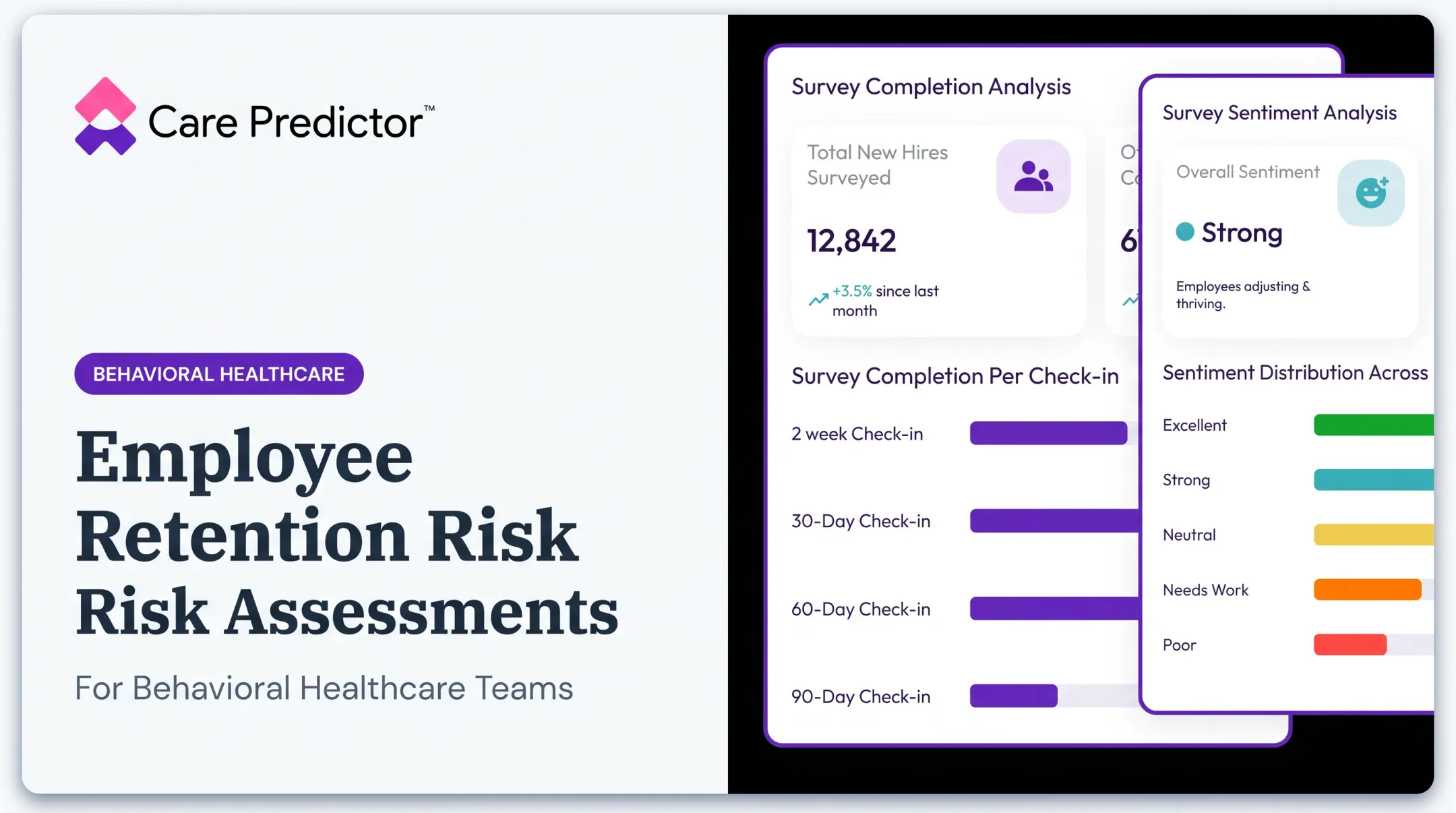
Care Predictor's analytics dashboard illustrates how this plays out in practice by connecting workforce data, treatment outcomes, revenue, census, and turnover in one filterable view. One customer's 12-month snapshot showed a 13% AMA rate and 87% treatment completion, figures tracked alongside staffing and utilization so leaders could see how workforce stability and patient outcomes moved together.
Measuring Impact
A technically accurate model can still fail if nobody trusts it or uses it. Relevant measures include:
- Calibration (do predicted risks match observed rates?)
- False-positive and false-negative rates
- Timeliness of alerts
- Effect on access, quality, and patient experience
- Staff workload and resource utilization
Care Predictor's own outcome tracking makes this distinction concrete: across a two-year dataset of 7,325 treatment episodes, therapists scoring 80+ on their Care Profile completed 25% more treatments and lost 29% fewer patients to leaving against medical advice. Those figures show a measured downstream result tied to a specific staffing signal, not model accuracy alone.

Challenges, Risks, and a Responsible Implementation Framework
Predictive analytics in healthcare runs into common obstacles:
- Fragmented systems and inconsistent data
- Limited in-house analytics expertise
- Integration costs
- Privacy and security concerns
- Model bias and lack of explainability
- Alert fatigue
- Resistance from staff or clinicians
A sepsis-prediction case illustrates why local validation matters so much. One external evaluation found that a widely used sepsis model missed 67% of actual sepsis cases while still triggering alerts in 18% of all hospitalizations — a combination that burns clinician trust fast. Every model needs local sensitivity, calibration, and workload testing before rollout.
A workable implementation sequence looks like this:
- Define the problem you're actually trying to solve.
- Establish governance before you touch the data.
- Audit data readiness: completeness, consistency, representativeness.
- Pilot in a controlled, limited workflow.
- Validate across the relevant patient or staff groups, not just in aggregate.
- Train users on what the model does and doesn't do.
- Monitor outcomes continuously.
- Improve or retire the model as performance data comes in.
Responsible use also requires:
- Transparency about intended use
- Role-based access
- Documented limitations
- Ongoing bias testing
- A clear process for staff to contest or correct a model's output
Skipping any of these steps is how good technology becomes a tool nobody trusts.

Predictive Analytics in Behavioral Healthcare: From Workforce Intelligence to Better Care
Behavioral-health providers face a reality most other specialties don't contend with at the same intensity: the clinician relationship often is the treatment. That makes workforce stability a clinical variable, not just an HR metric.
This is why predictive analytics in behavioral health increasingly extends beyond patient outcomes into hiring, onboarding, engagement, and burnout risk. Workforce data can help organizations ask better questions — before and after hiring:
- Does this candidate fit the role, team, and care environment?
- Where are interview assessments inconsistent across hiring managers?
- Which new hires need extra onboarding support?
- What factors correlate with longer tenure on this specific team?
None of this should function as an automatic hiring or firing decision. It's an input, not a verdict.
Stable teams tend to support stronger continuity of care. Frequent clinician turnover disrupts the therapeutic relationships patients depend on, which is exactly why staffing predictions matter as much as patient-risk predictions in this field.
Care Predictor was built around this idea. It's a behavioral-health workforce intelligence platform that combines behavioral science and data analytics across the employment lifecycle: pre-hire assessment, interviewing, prediction, and ongoing engagement. Its Care Profile assessments score candidates across 24 research-verified behavioral attributes linked to collaborative, high-retention relationships with clients and peers.

A few data points from the platform's own validation work:
- Therapists scoring 80+ on their Care Profile completed 25% more treatments and lost 29% fewer patients to leaving against medical advice (7,325 tracked episodes).
- At Ocean View Psychiatric Hospital, use of the Care Predictor Index was associated with a 9% improvement in treatment completion and a 43% reduction in AMA rate.
- At Alter Behavioral Health, leadership used four years of Care Predictor data to track provider reliability and strengthen therapeutic alliance across clinical and operational workflows.
Care Predictor is a workforce intelligence tool, not a clinical diagnostic platform. It does not predict individual patient diagnoses or treatment outcomes directly. It helps organizations build and retain the teams that drive those outcomes.
Because workforce models influence hiring and retention decisions, organizations evaluating any vendor in this category should ask:
- How was the model validated, and on what populations?
- How is fairness tested across different candidate and employee groups?
- How explainable are the scores to hiring managers and staff?
- What security certifications and data protections are in place?
- Who has access to the data, and under what controls?
- What implementation support is provided?
- How does the platform preserve human judgment rather than override it?
Frequently Asked Questions
What is predictive health analytics?
Predictive health analytics uses healthcare data, statistical methods, and machine learning to estimate the likelihood of future health or operational outcomes. It produces probabilities, not certainties, and works best alongside clinical judgment.
What are some applications of predictive analytics in healthcare?
Common applications include clinical risk identification, early intervention, personalized care planning, population health management, staffing and resource allocation, patient flow forecasting, and fraud or anomaly detection in claims.
What are five common predictive analytics models?
Regression, classification, decision trees or random forests, clustering, and time-series forecasting are the five most commonly referenced model types. The right choice depends on the question being asked and the data available.
What are the four P's of health analytics?
The "four P's" refer to P4 medicine — predictive, preventive, personalized, and participatory. That is a systems-medicine framework, not the usual descriptive, predictive, and prescriptive analytics categories.
What are the main challenges of predictive analytics in healthcare?
Main challenges include fragmented data, uneven data quality, privacy and security rules, model bias, limited explainability, and integration cost. Adoption also stalls when clinical staff do not trust or use the outputs.
How can healthcare organizations use predictive analytics responsibly?
Responsible use requires defined use cases, representative training data, rigorous validation, human oversight, transparent documentation of limitations, equity checks across populations, and ongoing measurement of real-world impact — not just model accuracy.