In behavioral healthcare, that erosion carries extra weight. When a clinician leaves, patients lose continuity of care, treatment plans get disrupted, and the therapeutic alliance that took months to build can unravel in a single transition.
The scale of the problem is hard to ignore. In a 2023 survey, National Council's survey found that 93% of behavioral health workers reported experiencing burnout, and 62% described it as moderate or severe. Nearly half said workforce shortages had them weighing other job options.
Retention risk assessments give leaders a way to spot these pressures before they turn into resignation letters. This guide covers what they are, why they matter in behavioral health settings, and how to run one without turning it into surveillance.
Key Takeaways
- Retention risk assessment is a structured way to spot turnover factors early, before resignation
- Each assessment weighs likelihood of leaving against the role's operational impact
- Findings should spark supportive conversations and targeted action, not employee labels
- Behavioral-science tools and workforce data help providers build steadier, more satisfied teams
What Is an Employee Retention Risk Assessment?
An employee retention risk assessment is a structured way to identify the conditions that make someone more likely to leave, and what it would cost the organization if they did. It's diagnostic, not predictive. It points to patterns worth investigating, not a guaranteed outcome.
It's easy to confuse this with other HR tools, but each serves a different purpose:
- Engagement survey – measures how involved and enthusiastic employees feel right now
- Performance review – evaluates current output and future potential, not flight risk
- Exit interview – captures feedback after someone has already decided to leave
- Turnover-rate analysis – counts separations that already happened
A retention risk assessment draws from all of these but focuses on what's still fixable, before an employee hands in notice.
Two Dimensions of Risk
Individual risk looks at whether a specific employee is becoming less committed. Common indicators include:
- Stalled growth
- Rising workload without added support
- Weak connection with their manager
- Role mismatch
- Declining recognition
Position risk looks at what happens if that person walks out the door. It depends on operational reality, not how replaceable someone "feels":
- How scarce their clinical specialization is
- The strength of their patient relationships
- Whether they carry leadership or supervisory duties
- How difficult the role is to recruit for
- How long a replacement would need to reach full productivity
Common Approaches
Organizations typically draw on multiple methods:
- Manager-led checklists
- Stay interviews
- Pulse surveys
- Structured assessments
- Workforce analytics
- Behavioral-science-informed platforms
None of these produces a definitive prediction on its own. A single risk score is a prompt to look closer, not a verdict on someone's future with the organization.
Why Employee Retention Risk Assessments Matter in Behavioral Healthcare
When a clinician leaves a behavioral health team, the fallout rarely stays contained to HR. Patients lose continuity, remaining staff absorb extra caseloads, and institutional knowledge about complex cases disappears overnight.
SAMHSA's burnout guidance for behavioral health organizations points to real organizational costs tied to turnover: lost clinical hours, higher recruitment spending, and disruptions to client care. These aren't abstract risks; they show up in overtime budgets and strained teams.
The research on care outcomes is more nuanced than it might seem. A clinician turnover study of two community behavioral health centers found that 24% of clients experienced a clinician change over a 12-month period. Outcomes didn't uniformly worsen: older clients saw sharper declines in functioning, while some clients with very low baseline functioning actually improved. Turnover's impact depends on context, not a universal rule.

That nuance is exactly why assumption-based retention decisions fall short. "High performer means low risk" and "quiet team means healthy team" are common shortcuts, and both are frequently wrong.
Common Risk Drivers
Retention risk assessments tend to surface the same handful of pressures, repeatedly:
- Burnout, workload, and scheduling pressure with insufficient recovery time
- Limited career development or unclear progression
- Compensation, benefits, or recognition gaps
- Manager-employee friction and low psychological safety
- Role misalignment or a fading sense of connection to patient outcomes
Weighing Probability Against Impact
Not every risk deserves the same response. A clinically critical role carrying moderate risk often needs faster attention than a lower-impact role showing high immediate risk. Combining likelihood with consequence helps leaders prioritize where to spend limited time first.
How an Employee Retention Risk Assessment Works – Step by Step
A good retention risk assessment does three things: it identifies conditions leaders can actually act on, it protects employee dignity and privacy, and it closes the loop between insight and support. It should never function as covert surveillance or a shortcut to automatic termination decisions.
Step 1: Define the Objective
Before collecting a single data point, get clear on what the assessment needs to answer. Is this about workforce-wide risk, prioritizing critical roles, supporting manager conversations, evaluating onboarding, or investigating a pattern on one specific team?
The objective determines which measures matter most: staff stability, retention, vacancy duration, internal mobility, workload, satisfaction, or continuity of patient care.
Step 2: Gather Inputs
Combine quantitative and qualitative sources rather than relying on one:
- Voluntary turnover trends and tenure data
- Absenteeism and schedule or workload indicators
- Internal mobility patterns
- Stay interviews, pulse surveys, and one-to-ones
- Exit interview themes and manager observations
Layer in role-level context too: clinical specialization, patient relationship responsibilities, leadership dependency, and how long a replacement would take to reach full productivity. Skip sensitive personal data that doesn't inform the decision at hand.
Step 3: Organize and Validate the Information
Segment findings by role, location, department, tenure, or manager, only where it's legally and ethically appropriate.
Before drawing conclusions, check for gaps: incomplete data, stale responses, response bias, inconsistent manager ratings, or patterns that could reflect demographic or disability-related bias rather than genuine risk.
Employees should know, in plain terms, how their information is collected, who can see it, and how it will be used.
Step 4: Assess Individual and Position Risk
Score individual indicators: growth alignment, recognition, workload, manager relationship, role fit, wellbeing, belonging, and connection to the mission.
Separately, weigh position risk: the effect of departure on patient continuity, team capacity, specialized knowledge, leadership coverage, and replacement difficulty.
A low-, moderate-, or high-priority framework can guide where to focus. It shouldn't become a label stamped on an employee's file.
Step 5: Interpret Results Through Human Conversations
Numbers don't explain lived experience. Validate findings in a respectful stay interview or one-to-one rather than assuming a score tells the whole story. Useful questions include:
- What would make you want to stay here long-term?
- What's making this role harder than it needs to be?
- What support would actually help right now?
- Has anything about your expectations changed?
Keep these conversations separate from performance management. Employees shouldn't feel pressure to give answers that protect their job rather than reflect reality.
Step 6: Act, Monitor, and Reassess
Match the response to the actual issue, not a generic retention playbook:
- Clarify role expectations
- Rebalance workload where feasible
- Improve onboarding and open development paths
- Strengthen manager communication and recognize contributions
- Revisit compensation and scheduling when needed
Assign an owner, a timeframe, and a follow-up measure to each action. Reassess regularly. Retention risk shifts after leadership changes, workload spikes, or role redesigns, so a one-time assessment goes stale fast.

Example: Picture a mid-career clinician at a residential treatment provider who still meets every clinical benchmark but has started showing strain. Heavier caseloads, no clear next step, and a distant manager relationship are the warning signs.
A manager-led check-in confirms the workload concern and surfaces interest in supervisory training. Leadership adjusts the caseload, enrolls the clinician in a development track, and schedules a 60-day follow-up, without ever suggesting the clinician was flagged as a flight risk.
How Care Predictor Can Help
Care Predictor is a behavioral-health workforce intelligence platform built on the belief that the quality of care depends on the people delivering it. It combines behavioral science with data analytics across the employee lifecycle, from the first interview through year three.
On the hiring side, Care Predictor's ASSESS, INTERVIEW, and PREDICT tools give leaders a more objective read on candidate fit before an offer goes out. That matters for retention too: in an internal study tracking 7,325 treatment episodes, therapists scoring 80 or above on their Care Profile completed 25% more treatments and lost 29% fewer patients to discharge against medical advice, compared to lower-scoring peers.

Once someone is hired, the platform helps managers catch risk early:
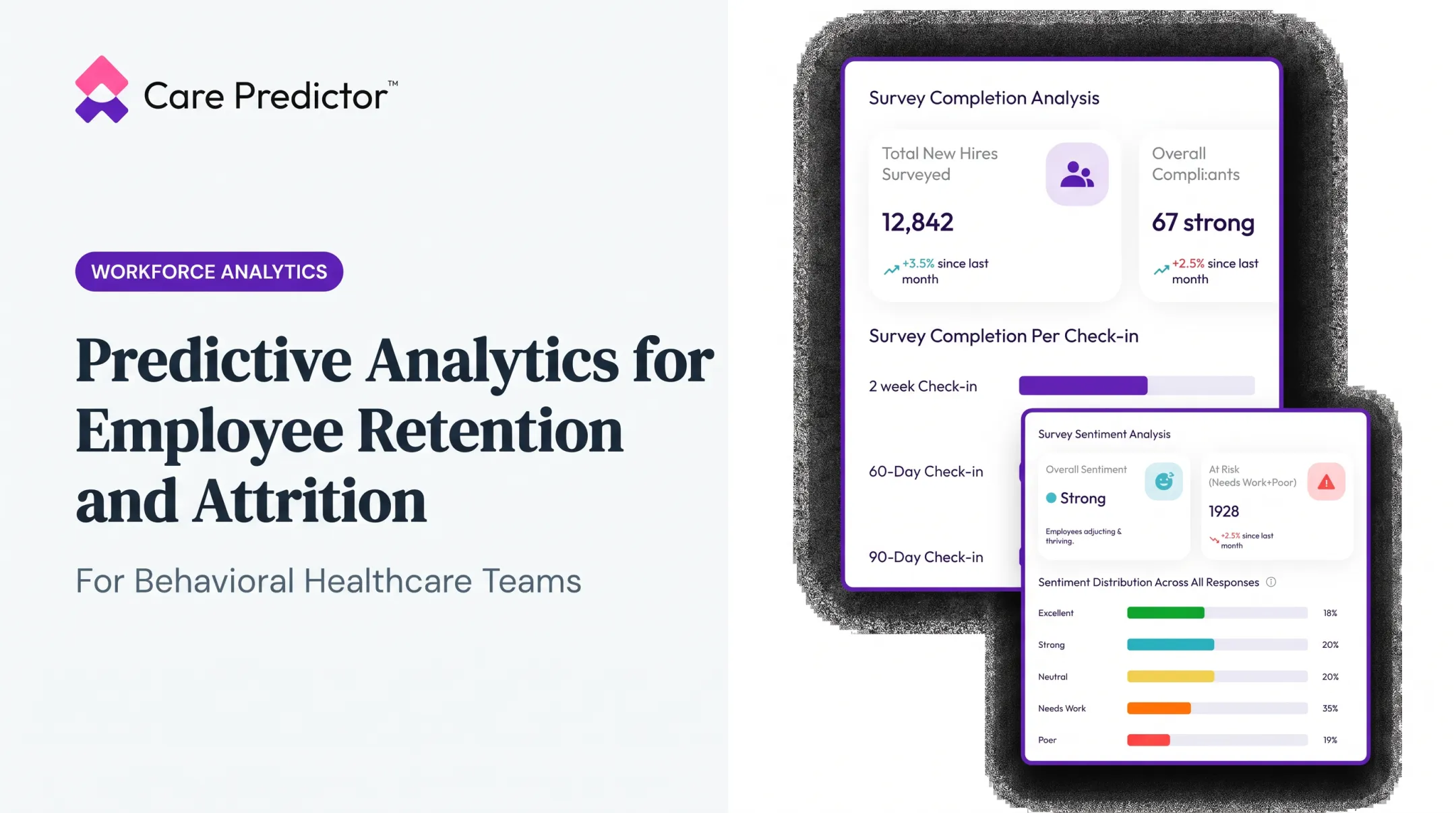
- Pulse surveys at 2 weeks, 30, 60, and 90 days surface onboarding friction, workload strain, and satisfaction
- Retention Intelligence applies sentiment analysis to flag pressure before burnout turns into an open role
None of this replaces a manager's judgment or a genuine conversation. Care Predictor's team is explicit about that: technology should strengthen human connection, not substitute for it. The data surfaces patterns; leaders still bring the context, empathy, and follow-through.
For organizations managing 150+ employees across multiple sites, this kind of visibility can be the difference between catching a workload problem in week six and discovering it the week a resignation letter lands.
Conclusion
Retention risk assessments won't predict every resignation; no tool can. What they do is create earlier visibility into the individual pressures, role dependencies, and organizational conditions that erode staff stability long before someone gives notice.
In behavioral healthcare, that early visibility has downstream effects most industries don't share. A clinician's decision to stay or go touches patient continuity, treatment outcomes, and the workload of everyone left behind on the team.
The assessment itself is only half the equation. Its value depends on what leaders do with it: turning insight into a genuine conversation, a specific action, and a plan to check back in. Build that habit and refine it with evidence and employee feedback, and the data starts doing what it's meant to do: keep good people where they can keep doing good work.
Frequently Asked Questions
What should an employee retention risk assessment include?
It should combine individual retention indicators, the role's operational impact, direct employee feedback, and relevant workforce data. Privacy safeguards and a clear follow-up action plan are essential, not optional add-ons.
What is an employee retention risk assessment?
It's a structured process for identifying conditions that may increase the likelihood or impact of employee turnover, before a resignation happens. It's diagnostic, pointing leaders toward areas worth a closer look.
Why are employee retention risk assessments important?
Early identification of retention risk supports staff stability, reduces disruption from unplanned vacancies, and improves workforce planning. In behavioral healthcare, it also protects continuity of patient care.
How do you assess employee retention risk?
Combine workforce data, stay interviews, pulse feedback, and manager conversations with an analysis of each role's operational impact. Reassess regularly, since risk shifts after leadership, workload, or role changes.
What is the difference between individual risk and position risk?
Individual risk concerns how likely a specific employee is to leave. Position risk concerns how disruptive and difficult it would be to replace that role if they did.
How should leaders respond to retention risk?
Validate the concern through a respectful, judgment-free conversation, identify the real underlying issue, and choose a targeted intervention. Then monitor whether conditions actually improve over time.