Leaders can't fix what they don't measure. A well-built nursing job satisfaction questionnaire captures both the broad sentiment ("how do you feel about working here?") and the specific drivers behind it: staffing adequacy, leadership trust, workload, safety, professional growth, and whether nurses feel emotionally equipped for the work.
This guide walks through what to ask, which tools fit behavioral health environments, how to administer surveys without damaging trust, and how to turn responses into decisions that actually move retention numbers.
Key Takeaways
- Strong questionnaires pair rating scales with targeted open-ended prompts—not one or the other.
- Select tools for anonymity, frontline access, reporting depth, and recurring pulse surveys.
- Behavioral health programs need to measure therapeutic workload and psychological safety, not just pay and schedules.
- Survey results only matter when tied to retention, onboarding, and workforce planning.
Why Nursing Job Satisfaction Surveys Matter in Behavioral Health
Behavioral health nursing carries a distinct burnout profile. Moral distress, exposure to crisis situations, and the emotional weight of psychiatric and addiction care compound the usual pressures of bedside nursing. The data backs this up.
NSI Nursing Solutions' 2025 retention report, drawing on 2024 data from 450 acute-care hospitals, found behavioral-health RN turnover at 20.8%, compared with 16.4% for hospital RNs overall: a meaningful gap worth tracking separately (NSI National Health Care Retention & RN Staffing Report).
Intent-to-leave data tells a similarly sobering story. The National Council of State Boards of Nursing's 2025 research release reported that 39.9% of RNs intended to leave nursing or retire within five years. Intention is not outcome, but it is an early warning most organizations never capture in formal surveys.
Staffing adequacy connects directly to burnout. A 2023 CDC analysis found health workers reporting insufficient staffing had 2.73 times the odds of reporting burnout symptoms compared to those who felt adequately staffed.

Satisfaction Isn't the Same as Engagement
These two terms get used interchangeably, but they measure different things:
- Job satisfaction reflects how an employee evaluates their current role (pay, conditions, workload, day-to-day experience).
- Engagement captures commitment, discretionary effort, and connection to the organization's mission.
A nurse can report moderate satisfaction with scheduling while still feeling disengaged from leadership's direction. Measuring only one gives an incomplete picture.
One Score Isn't Enough
A single annual satisfaction number tells you almost nothing about why. Break results down by role, unit, tenure, and shift whenever sample sizes allow it without exposing individuals. Then pair those trends with operational data (turnover, vacancy rates, absenteeism, overtime hours) to see whether perceived problems track with workforce outcomes.
Care Predictor's turnover analytics track headcount, average tenure, and terminations by department and location, giving leaders a concrete baseline to compare against survey sentiment.
What to Include in a Nursing Job Satisfaction Questionnaire
Start with the fundamentals: overall satisfaction, likelihood of recommending the organization, likelihood of job-searching in the next six months, and sense of purpose in the work. These four questions form your benchmark trendline. Keep them consistent across every survey wave.
From there, build out topic-specific sections.
Staffing, Workload, and Scheduling
- Do staffing levels support safe, consistent patient care?
- Are caseloads and acuity manageable given current staffing?
- Are shifts predictable enough to plan around?
- Can staff reliably take breaks and use paid time off?
Leadership, Teamwork, and Psychological Safety
- Do managers listen and follow up on concerns?
- Can staff raise patient-care or safety issues without fear of retaliation?
- Are organizational decisions communicated clearly and in advance?
- How well do clinical and nonclinical teams collaborate during handoffs and crises?
Care Predictor's qualitative feedback analysis across client organizations has repeatedly surfaced the same pattern: staff rate supportive, communicative managers as a top strength, but limited in-person supervisor interaction caused by staffing shortages shows up just as often as an improvement area. That tension between wanting more manager contact and managers being stretched thin is exactly the kind of insight a well-designed questionnaire exposes.
Compensation, Growth, and Safety
- Is pay and benefits fair, with recognition for good work?
- Do you have access to training, mentorship, and certification support?
- What share of time goes to direct care versus administrative tasks?
- How adequate is support for workplace violence, de-escalation, and moral distress?
- How confident are you in the organization's response to critical incidents?
Fewer than 15% of behavioral health organizations routinely assess therapeutic alliance, the quality of the nurse-patient relationship itself. That is a measurable blind spot worth closing with a dedicated question or two.
Close with open-ended prompts like "What is one change that would most improve your experience?" and "What's making it harder to provide consistent, compassionate care?" Comments catch what rating scales miss: context, nuance, and the specific incident behind a low score.
Structure tip:
- Keep recurring benchmark questions identical across survey waves
- Rotate topic modules (leadership one quarter, safety the next)
- Limit demographic questions to what analysis requires
- Always include a "not applicable" option
How to Choose the Right Survey Tool
Not every survey tool fits a behavioral health workforce. The differences matter more than they first appear.
Match the Tool to Your Organization's Complexity
| Tool Category | Strengths | Best Fit |
|---|---|---|
| General survey software | Flexible, low cost | Small teams, one-off surveys |
| Employee engagement platforms | Templates, dashboards, benchmarks, action-planning | Mid-size organizations with recurring listening programs |
| Healthcare-specific workforce tools | Role-based analysis, lifecycle data, predictive insights | Multi-location providers connecting hiring, engagement, and retention |
Anonymity, Access, and Reporting Must-Haves
Nurses won't answer honestly if they suspect a manager can trace their response back to them. Before selecting a tool, confirm it offers:
- True anonymous or confidential response collection
- Minimum group-size thresholds (commonly five responses) before data or comments display
- Separation of identifying data from survey answers
- Mobile-friendly access, since most nurses aren't sitting at a desk during a shift
- Reporting that segments by unit, role, and date range, with export options
Also verify security posture directly. Ask about current certifications like ISO 27001:2022 or SOC 2, data retention policies, and access controls — don't take a vendor's homepage badge at face value.
Where a Platform Like Care Predictor Fits In
When those must-haves point toward a healthcare-specific option, the next step is seeing how a purpose-built platform actually works in practice.
Care Predictor is a workforce intelligence platform built for behavioral health organizations, not a general-purpose survey tool. It combines anonymous engagement surveys, eNPS tracking, and 30/60/90-day onboarding pulse checks with AI-driven sentiment analysis on open-ended comments. Surveys can go live within seven days of signup, with no EMR integration required.
The real value is connecting those responses to hiring data, turnover analytics, and retention trends in one filterable dashboard. For organizations already using Care Predictor's pre-hire Care Profile assessments, that creates a continuous thread from candidate evaluation through ongoing engagement. The platform is ISO 27001:2022 and SOC 2 certified for data security.

How to Design and Administer the Questionnaire Responsibly
Before writing a single question, decide what decision the survey needs to inform. Reducing early turnover and understanding burnout drivers call for different question sets.
A few non-negotiables:
- Write single-focus questions. Avoid double-barreled wording like "Are staffing and scheduling manageable?" Split it into two questions.
- Pilot with a small group of nurses and managers first to catch confusing wording or missing response options.
- Explain the purpose upfront: expected completion time, anonymity protections, and who sees results.
- Distribute thoughtfully. Email, SMS, QR codes, or scheduled paid time all work better than pressure from a direct supervisor to complete it on the spot.
- Set a repeatable cadence. Use a longer baseline survey followed by shorter pulse surveys, and keep core questions unchanged for trend comparison.
When you report results, protect anonymity first. Set a minimum reporting threshold (five responses is a common industry default) and never publish results for groups small enough that individuals could be identified.
Build in a clear process for any comment that discloses an immediate safety risk or threat of harm.
How to Analyze Results and Turn Feedback Into Action
A low satisfaction score is a symptom, not a diagnosis. The real work starts after the survey closes.
Separate Symptoms From Root Causes
A dip in satisfaction could stem from staffing gaps, a specific manager's behavior, documentation burden, or compensation concerns. Use follow-up questions and open-ended comments to narrow it down before acting.
Then check whether the theme correlates with actual workforce data: early-tenure exits, overtime hours, transfer requests, or vacancy duration by unit.
Care Predictor's internal data shows how this plays out in practice. One organization's dashboard posted an eNPS of +62 against an industry average of +12, with 68% promoters and only 10% detractors. That signal held up on the floor: a 5% turnover rate across 145 active employees.
Close the Loop Publicly
Build a simple "you said, we did" communication log:
- Share the main findings honestly, including what won't change immediately
- Name an owner for each action item
- Set an expected timeframe
- Equip managers to discuss results without identifying individual respondents
Track What Happens Next
Watch both leading and lagging indicators after any intervention: response trends on the next survey, turnover, absenteeism, and safety-reporting rates.
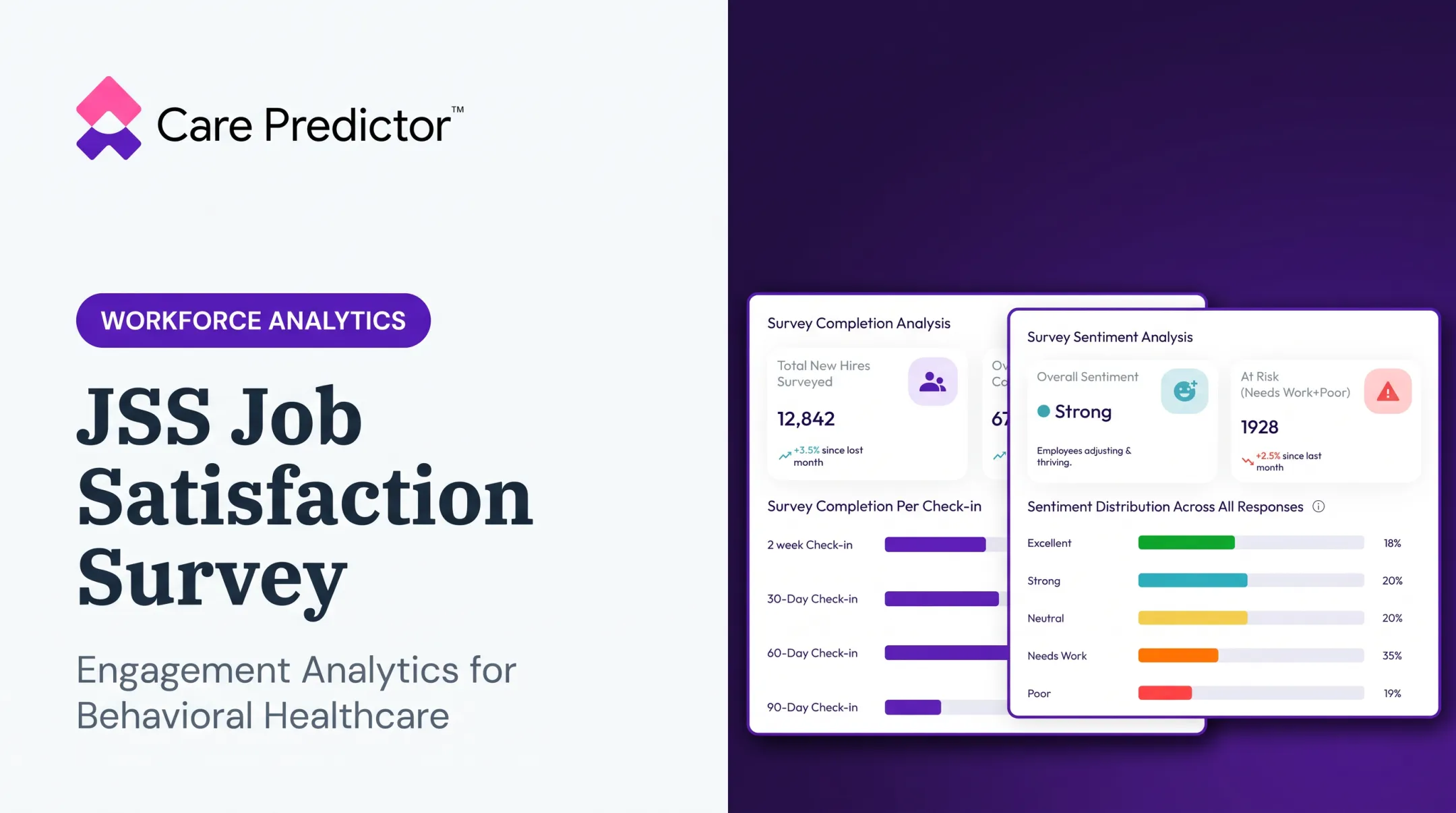
Survey completion itself is a useful signal. Across Care Predictor's platform, completion runs around 92% at the two-week check-in but drops to 54% by day 90 — a pattern worth watching if your own numbers fall off the same way.
Resurvey with a follow-up pulse and real conversations. Did staff notice the change? Did the original problem actually improve? Use the data to sharpen manager coaching and stay interviews, not to replace them.

Frequently Asked Questions
What should be included in a nursing job satisfaction questionnaire?
Cover overall satisfaction, staffing and workload, scheduling, leadership, communication, safety, professional growth, recognition, role alignment, retention intent, and open-ended feedback prompts.
What is the best tool for conducting a nurse satisfaction survey?
It depends on your organization's size, anonymity requirements, and whether you need basic survey collection or broader workforce intelligence connecting hiring, engagement, and retention data.
How often should healthcare organizations survey nurses?
Run a baseline survey annually, then use shorter pulse surveys on a consistent cadence. Timing should match your organization's capacity to act on the results, not an arbitrary schedule.
How can organizations protect anonymity in nurse satisfaction surveys?
Use anonymous or confidential collection, set minimum reporting group sizes (commonly five), suppress small segments, and restrict manager access to individual-level responses.
What is the difference between job satisfaction and employee engagement?
Satisfaction measures how an employee evaluates their current work experience. Engagement measures commitment, discretionary effort, and connection to the organization's mission.
How should leaders act on nurse survey results?
Identify a small number of priorities, assign an accountable owner to each, communicate findings transparently, implement visible changes, and track workforce indicators to confirm improvement.